When Your Commercial Steam Boiler Fails, Every Minute Counts
Emergency boiler repair is the process of diagnosing and fixing a boiler that has stopped working safely or effectively — and needs immediate professional attention.
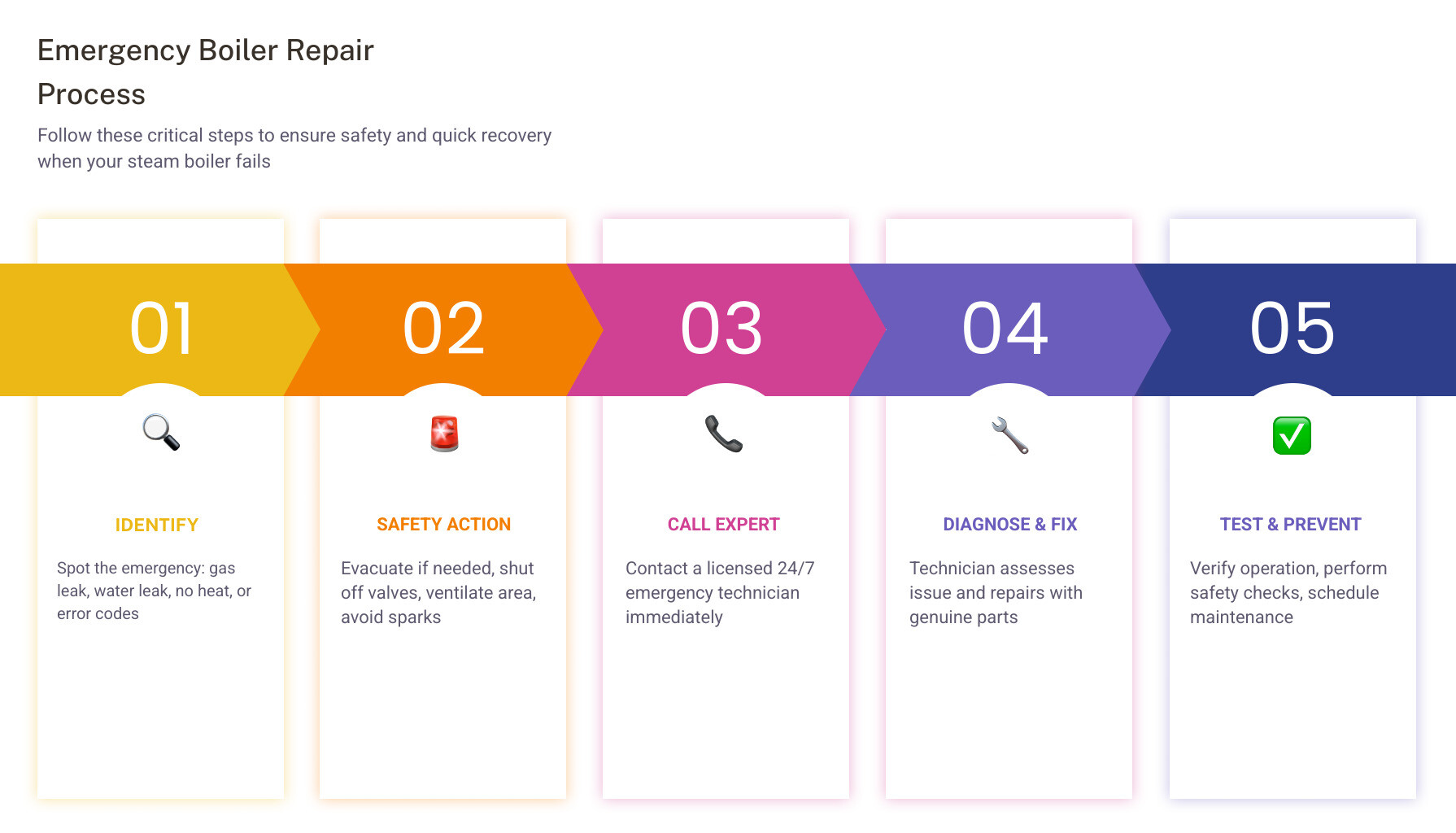
If your commercial steam boiler just went down, here’s what to do right now:
- Gas leak? Evacuate the building, avoid all switches and open flames, open windows, and call your gas company and emergency services immediately.
- Water leak? Locate and shut off the main water supply valve, then call a licensed technician.
- No heat or error codes? Do not attempt repairs yourself. Call a Gas Safe or licensed heating technician for emergency service.
- Carbon monoxide alarm triggered? Evacuate immediately and call 911.
Steam boilers are workhorses. They run quietly in the background, keeping your building warm through brutal Massachusetts winters. But when something goes wrong — a pressure spike, a leaking valve, a sudden loss of heat — the impact is immediate and serious.
Downtime isn’t just uncomfortable. In commercial settings, it can disrupt operations, endanger occupants, and lead to costly damage.
The good news: most boiler emergencies are manageable when you know what to look for and who to call. This guide walks you through exactly that — from spotting the warning signs early to getting your system back online fast, and keeping it that way.
Identifying and Handling an Emergency boiler repair
When we talk about a boiler emergency, we aren’t just talking about a chilly office. We are talking about situations that threaten the structural integrity of your building or the safety of everyone inside. In Massachusetts, where winter temperatures regularly drop below freezing, a loss of heat can lead to burst pipes and massive property damage within hours.

Immediate Steps for an Emergency boiler repair
If you suspect your system is failing, your first priority is safety. Unlike a standard service call, an Emergency boiler repair requires swift, decisive action to prevent a catastrophe.
- Gas Leaks: Natural gas is naturally odorless, but utilities add a “rotten egg” or sulfur smell so you can detect it. If you smell this, do not touch any electrical switches. A single spark from a light switch or a phone can ignite the gas. Open windows, evacuate the premises, and call the gas company from a safe distance.
- Water Leaks: A leaking boiler valve or a puddle around the unit might seem minor, but steam systems operate under pressure. A small leak can quickly turn into a flood. Locate your main water shut-off valve and turn it clockwise to stop the flow.
- Carbon Monoxide (CO): This is the “silent killer” because it is colorless and odorless. If your CO detectors go off, or if you notice a yellow, flickering pilot light instead of a crisp blue flame, evacuate immediately. Symptoms of CO poisoning include headaches, dizziness, and nausea. For more information on identifying these risks, refer to the CDC guide on carbon monoxide poisoning.
- Ventilation: If it is safe to do so, ensure the boiler room has adequate ventilation. However, if gas is present, your only job is to get out.
For more complex issues that don’t involve immediate danger but still require urgent attention, you can find More info about boiler services to see how professional diagnostics work.
Common Signs of Steam Boiler Failure
How do you know if you’re facing a standard repair or a true emergency? Often, the boiler will “tell” you something is wrong before it shuts down completely.
- Kettling: If your boiler sounds like a giant tea kettle whistling or banging, this is usually caused by scale buildup on the heat exchanger. This restricts water flow and can cause the unit to overheat or even crack.
- Strange Noises: Beyond kettling, listen for deep banging (water hammer), gurgling, or whistling. These often point to air in the system, pump failure, or low water pressure.
- Error Codes: Modern commercial boilers feature digital displays. If you see a flashing code, don’t ignore it. These codes are designed to shut the system down before a dangerous “dry fire” occurs.
- Inconsistent Heat: If some zones are boiling hot while others are freezing, your circulation pumps or zone valves may have failed.
| Feature | Standard Repair | Emergency Repair |
|---|---|---|
| Response Time | Scheduled within 24-48 hours | Immediate (within 1 hour) |
| Safety Risk | Low (e.g., minor efficiency drop) | High (e.g., gas leak, CO risk, freezing) |
| Operational Impact | Minimal disruption | Total system shutdown |
| Availability | Business hours | 24/7, 365 days a year |
Professional Qualifications for Emergency boiler repair
When the heat is off in the middle of a Nor’easter, you don’t want a “handyman” poking around your steam pipes. Steam boilers are complex, high-pressure systems that require specialized hydronics knowledge.
We ensure our technicians meet the highest industry standards:
- Licensed and Insured: We carry twice the legal minimum of liability insurance to protect your property.
- Specialized Training: Our team is trained in hydronics-a specific branch of plumbing that deals with water and steam heating. This is different from standard forced-air HVAC training.
- 24/7 Availability: Emergencies don’t wait for Monday morning. We provide around-the-clock support, including weekends and holidays.
- Fully Stocked Trucks: Our “warehouse on wheels” approach means we carry the most common failure parts (thermocouples, valves, gaskets, and controls) to achieve a high “first-time fix” percentage.
Preventing Future Nightmares with Proactive Care
The best Emergency boiler repair is the one that never has to happen. While some parts eventually wear out, the vast majority of boiler failures in Massachusetts are preventable through consistent, professional care.
The Role of Preventative Maintenance
Think of your boiler like a commercial vehicle. You wouldn’t drive a truck for 100,000 miles without an oil change; you shouldn’t run a steam boiler for years without a tune-up.
- Combustion Tuning: By adjusting the fuel-to-air ratio, we ensure the burner is firing efficiently. Research shows that professional combustion tuning can yield 1-3% fuel savings annually.
- Safety Checks: We inspect the low-water cut-off (the most critical safety device on a steam boiler) and the pressure relief valves to ensure they will function if a spike occurs.
- Scale Removal: We flush the system to remove the “sludge” and mineral deposits that lead to kettling and reduced heat transfer.
For a deeper dive into keeping your system running smoothly, check out More info about boiler care and our specific More info about winter maintenance checklist designed for our local climate.
Repair vs. Replacement Decision Factors
There comes a point in every boiler’s life where repairing it is like putting a new engine in a rusted-out car. When we arrive for an Emergency boiler repair, we provide an honest assessment of whether a fix is your best long-term move.
Key factors we consider:
- Boiler Age: Most commercial boilers have a lifespan of 15-25 years. If yours is approaching the two-decade mark, parts will become harder to find and more expensive to replace.
- Frequency of Repairs: If we’ve seen you three times this winter for different issues, the system is likely “nickeling and diming” you.
- Energy Efficiency: Older boilers might operate at 60-70% efficiency. Modern high-efficiency units can reach 95%+, often paying for themselves in fuel savings over a few years.
- Parts Availability: Some older brands no longer manufacture specific heat exchangers or controls. In these cases, we may have to substitute parts, which can be a complex and costly process.
If you’re considering an upgrade, read More info about choosing a boiler to understand which modern systems are best for Massachusetts buildings.
Reliable Heating Solutions in Massachusetts
At Accurate Baker Elman, we’ve spent over 30 years mastering the art of the steam boiler. We understand the unique challenges of heating older buildings in Franklin, MA, and the surrounding Norfolk County area. Whether it’s a century-old cast iron beast or a modern high-efficiency system, we have the tools and the expertise to keep the steam rising.
We serve a wide range of locations, ensuring that when you search for “boiler repair near me,” you find a team that actually knows your neighborhood. Our service area includes:
- Franklin, Norfolk, and Medway
- Wrentham, Bellingham, and Millis
- Holliston, Hopkinton, and Foxboro
- Newton, Waltham, and Watertown
- And many more communities throughout Greater Boston and the MetroWest.
We pride ourselves on being a Mitsubishi Electric Elite Diamond Contractor, but our roots are firmly planted in traditional hydronic heating. We offer 24/7 support because we know that a “no heat” situation in January is more than an inconvenience—it’s a crisis.
If you are currently facing a breakdown or simply want to ensure your system survives the next cold snap, reach out to us for Reliable heating services in Massachusetts. We’ll get your system running safely, efficiently, and—most importantly—reliably.