
Why Tankless Hot Water Heater Plumbing Is Transforming Massachusetts Homes
Tankless hot water heater plumbing is one of the most impactful upgrades you can make to your home’s water system. Here’s a quick overview of what it involves:
- On-demand heating: Water is heated only when you turn on the tap — no stored tank required
- Key plumbing connections: Cold water inlet, hot water outlet, pressure relief valve, and shutoff valves
- Fuel options: Natural gas, propane, or electric — each with different pipe and wiring requirements
- Sizing: Based on your peak flow rate (GPM) and how much the water temperature needs to rise
- Venting: Gas models need proper exhaust venting; electric models do not
- Maintenance: Annual flushing and descaling to keep the system running efficiently
If you’ve ever run out of hot water mid-shower on a cold Massachusetts morning, you already understand the problem tankless water heaters are designed to solve.
Traditional tank-style heaters store 40–80 gallons of hot water and keep it warm around the clock — even when you’re asleep or away. That constant reheating is called standby heat loss, and it quietly drains your energy budget every single day.
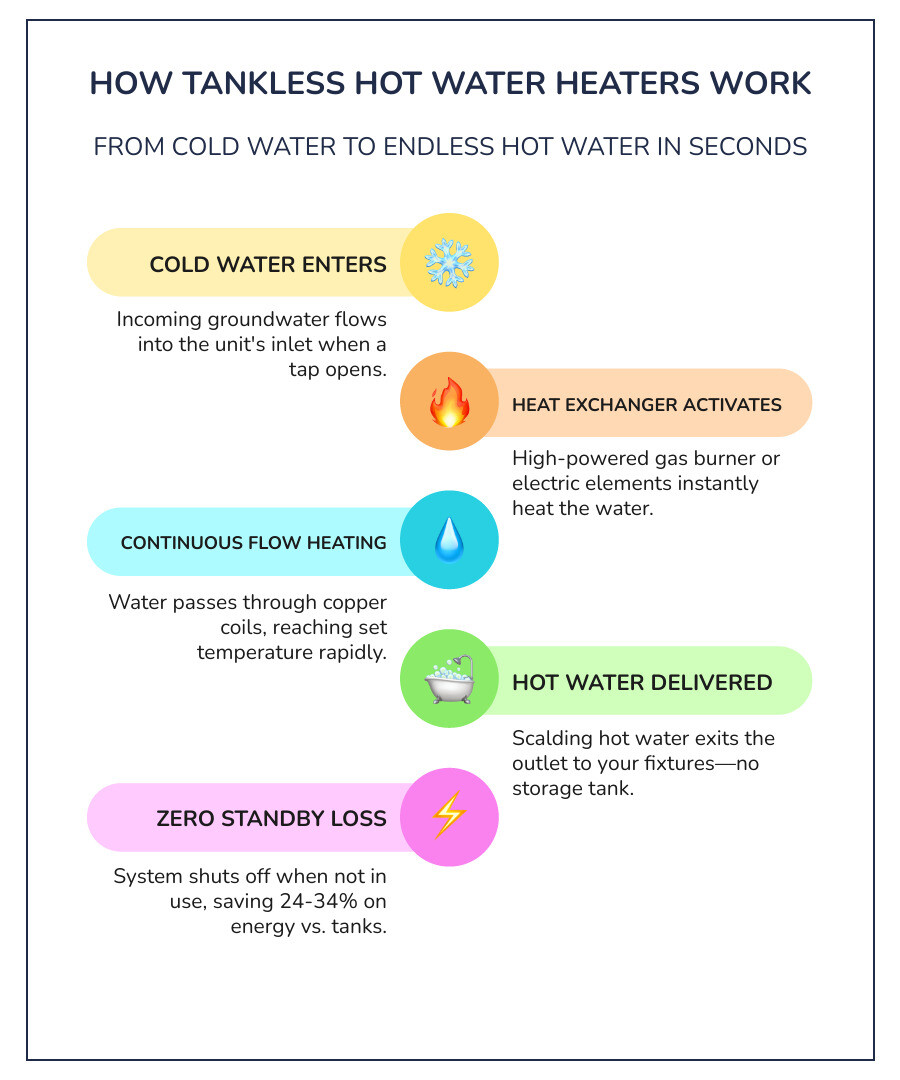
Tankless systems work differently. Cold water flows through the unit, gets heated instantly by a gas burner or electric element, and arrives at your tap hot — without ever sitting in a tank.
The results speak for themselves. According to the U.S. Department of Energy, tankless water heaters can be 24%–34% more energy efficient than conventional storage tank heaters in homes that use 41 gallons or less of hot water per day. They also last 20 years or more, compared to just 10–15 years for traditional tanks.
But the plumbing side of this upgrade is more involved than swapping one unit for another. Gas line sizing, venting, water connections, and electrical requirements all need to be right — or the system won’t perform safely or efficiently.
This guide walks you through everything you need to know.
Easy tankless hot water heater plumbing word list:
The Essentials of Tankless Hot Water Heater Plumbing
When we talk about tankless hot water heater plumbing, we aren’t just talking about a box on the wall. We are talking about a sophisticated system designed to flash-heat water the moment a faucet opens. Unlike a traditional tank that relies on a large reservoir, a tankless unit is a high-performance heat exchanger.
To get this right in a Massachusetts home—where groundwater temperatures can be quite chilly in the winter—the plumbing must be precise. This involves calculating the flow rate (how much water you need at once) and the temperature rise (how many degrees the unit must add to that cold incoming water).

The efficiency gains are significant. Research shows that tankless units can be 24%–34% more efficient than conventional storage tanks. For families in areas like Franklin or Medfield, this translates to saving 27-50% on fuel costs. When you consider that water heating accounts for about 20% of the average family’s energy expenses, those savings add up fast. You can learn more about how these systems stack up in our guide on tankless vs traditional water heaters.
How Tankless Systems Differ from Traditional Tanks
The biggest difference is the absence of a bulky storage tank. A traditional heater is essentially a giant kettle that stays on all day. A tankless unit, often called an “on-demand” heater, stays idle until it senses water flow.
When you turn on a hot water tap, a flow sensor triggers the gas burner or electric element. Cold water travels through a copper or stainless steel heat exchanger, absorbs heat instantly, and exits the unit at your desired temperature. This compact design saves a massive amount of floor space—a tankless unit is typically about the size of a suitcase, while a traditional tank can be 60 inches tall and 20 inches wide.
Beyond space, the internal components are designed for a longer life. Because they don’t store water, they aren’t as prone to the rust and scale buildup that eventually kills traditional tanks. This leads to a lifespan of 20+ years with proper care. For a deeper look at the pros and cons, check out the great water heater debate.
Sizing Your Tankless Hot Water Heater Plumbing for Peak Demand
Sizing is the most critical step in tankless hot water heater plumbing. If the unit is too small, your shower will turn lukewarm the moment someone starts the dishwasher. We size these units based on Gallons Per Minute (GPM) and Temperature Rise.
First, we look at your “peak demand”—the maximum amount of hot water you’ll need at any single moment.
Average GPM Demands:
- Standard Showerhead: 2.0 – 2.5 GPM
- Kitchen Sink: 1.5 GPM
- Bathroom Sink: 1.0 GPM
- Dishwasher: 1.0 – 2.0 GPM
- Washing Machine: 2.0 GPM
If you want to run a shower (2.5 GPM) and the dishwasher (1.5 GPM) at the same time, you need a unit that can handle at least 4.0 GPM.
Second, we calculate the temperature rise. In Massachusetts, our winter groundwater can drop to 40°F. To reach a comfortable 120°F shower, the unit must provide an 80°F temperature rise. Many units can provide high GPM in Florida (where water starts at 70°F) but struggle in the North. We always ensure your system is rated for our local climate.
Gas vs. Electric: Key Installation Requirements
Choosing between gas and electric isn’t just about the monthly bill; it’s about the infrastructure in your home.
Gas Tankless Units: These are the most common for whole-home use because they offer higher flow rates (typically 5 GPM or more). However, they have high BTU (British Thermal Unit) requirements. A standard tank heater uses about 40,000 BTUs, while a tankless unit can demand up to 199,000 BTUs. This often means we need to upgrade your gas line from a 1/2-inch pipe to a 1-inch pipe to ensure the unit doesn’t “starve” for fuel.
Electric Tankless Units: These are often easier to install because they don’t require venting. However, they draw a massive amount of electricity. A whole-home electric unit might require two, three, or even four 40-amp double-pole breakers. Most older homes in Norfolk or Walpole will need an electrical panel upgrade to support this. Electric units are generally better suited for “point-of-use” applications, like a single sink in a home addition.
Whether you go gas or electric, our plumbing services in MA can help evaluate your home’s current capacity.
Step-by-Step Guide to Tankless Hot Water Heater Plumbing Connections
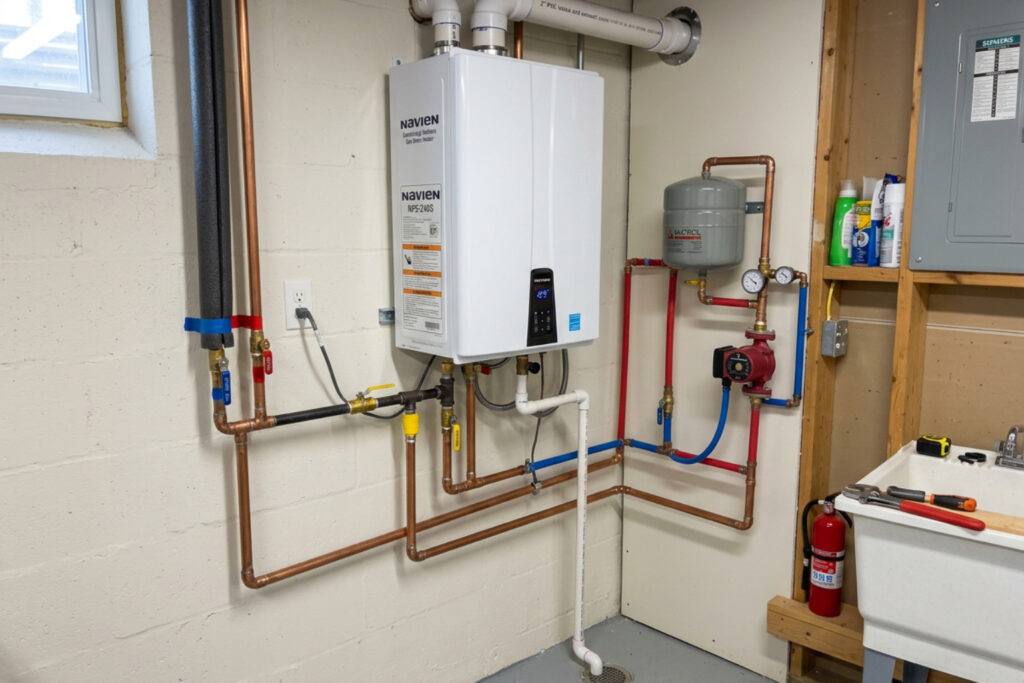
Once the unit is mounted securely to wall studs, the plumbing work begins. This is where the “magic” happens.
- Mounting: The unit must be level and secured with lag screws. We never rely on simple drywall anchors; these units are heavy and vibrate slightly when running.
- Water Line Connections: We use 3/4-inch copper pipe for most residential installs. A key component here is the service valve kit. These valves allow us to shut off the water to the unit and provide ports for annual descaling.
- Pressure Relief Valve (PRV): This is a non-negotiable safety feature. It protects the unit from excessive pressure.
- Dielectric Unions: If we are connecting copper pipes to a unit with different metal fittings, we use these unions to prevent galvanic corrosion.
- Purging the Lines: Before we turn the power on, we run water through the system to flush out any air or debris from the installation process.
For complex setups involving multiple units or specialized needs, our tankless water heater services ensure every connection meets local Massachusetts codes.
Venting and Safety Standards for Gas Models
If you choose a gas unit, venting is the most important safety consideration. Because these units burn a lot of fuel quickly, they produce significant exhaust.
- Non-Condensing Units: These exhaust very hot gases and require specialized Category III stainless steel venting to prevent corrosion and fire hazards.
- Condensing Units: These are more efficient. They capture extra heat from the exhaust, cooling it down enough that we can use inexpensive PVC or polypropylene venting. However, they produce acidic “condensate” (liquid), which must be drained away safely, often through a neutralizer.
- Termination Clearances: Vents must be located away from windows, doors, and air intakes to prevent carbon monoxide from re-entering the home.
The tankless water heater market is growing rapidly because of these high-efficiency condensing models, which make installation more flexible in modern homes.
Maintenance and Troubleshooting for Longevity
We like to say that a tankless heater is like a high-performance sports car—it’s amazing, but you can’t skip the oil changes.
Annual Flushing (Descaling): Massachusetts often has “hard water” containing minerals like calcium. Over time, these minerals bake onto the heat exchanger, acting like insulation and forcing the unit to work harder. Once a year, we use a pump to circulate a food-grade descaling solution (like white vinegar) through the unit for about an hour. This keeps the efficiency high and prevents the heat exchanger from failing.
Filter Cleaning: Most units have a small screen filter on the cold water inlet. We check this regularly to ensure sediment isn’t blocking the flow.
Recirculation Pumps: One common complaint with tankless is the “wait” for hot water (since there’s no hot water sitting in the pipes). Many modern units include internal recirculation pumps that keep hot water moving through your pipes, giving you instant heat at the tap.
For more ways to keep your home running efficiently, check out our tips for a greener plumbing system.
Conclusion: Is Tankless Right for Your Home?
Switching to tankless hot water heater plumbing is a smart investment for most Massachusetts homeowners. Between the space savings, the endless hot water, and the 20-year lifespan, it offers a level of comfort and efficiency that traditional tanks simply can’t match.
However, because of the complex gas, venting, and electrical requirements, this is not a project for the average DIYer. Improper installation can lead to carbon monoxide risks, gas leaks, or a voided manufacturer warranty.
At Accurate Baker Elman, we have over 30 years of experience serving neighbors in Franklin, Foxboro, Newton, and beyond. We understand the specific plumbing codes and climate challenges of our region. We can help you calculate your ROI, secure the necessary local permits, and ensure your new system is sized perfectly for your family’s needs.
Ready to stop worrying about your hot water supply? Contact us today for expert tankless water heater services and join the thousands of Massachusetts families making the switch to on-demand comfort.