
The Shift to On-Demand Hot Water
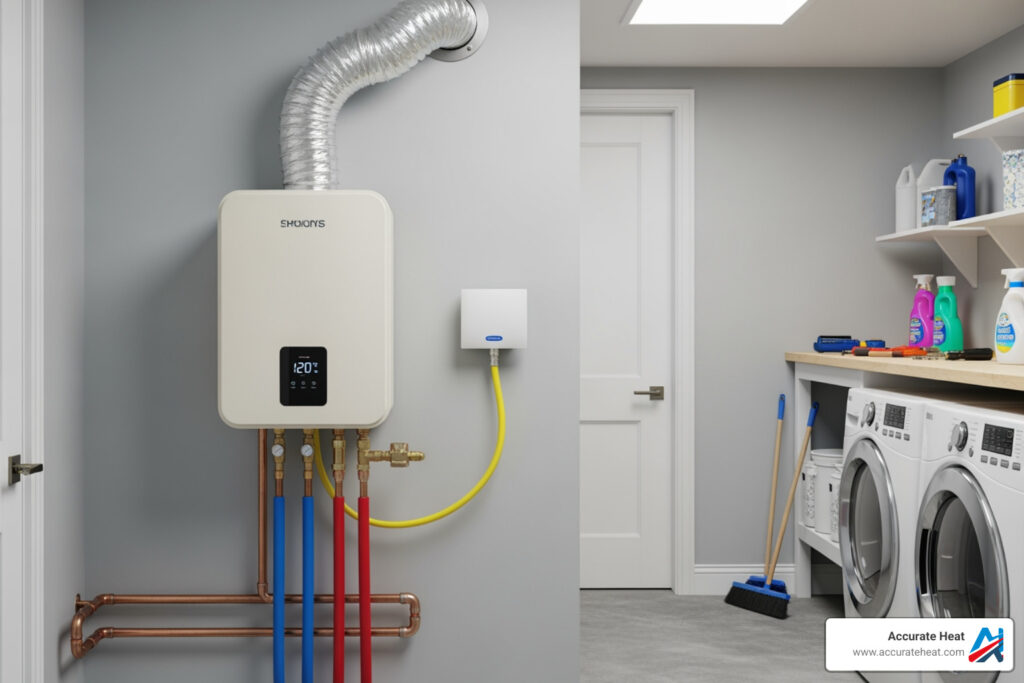
Indoor tankless water heater installation is a complex upgrade that replaces your traditional storage tank with a compact, wall-mounted unit that heats water only when you need it. This guide walks you through the entire process, but here’s what you need to know upfront:
What’s Involved in Installing an Indoor Tankless Water Heater:
- Remove your old tank water heater – Drain, disconnect, and dispose of the existing unit
- Mount the new tankless unit – Secure it to a wall with proper clearances
- Upgrade utilities – Gas lines often need sizing up (from 1/2″ to 1″ pipe), and electrical circuits must be adequate
- Install venting – Direct-vent systems must be properly sealed and terminated outdoors
- Connect water lines – Install isolation valves, pressure relief valves, and make watertight connections
- Test and startup – Purge air, check for leaks, adjust settings for your location
Why go tankless? These units can boost efficiency by up to 34% compared to standard tank heaters, last 15-20 years, and free up valuable floor space. But here’s the reality: this is not a simple DIY project.
The installation involves precise gas line work, electrical upgrades, and venting that must meet strict safety codes. Most homeowners spend $1,200-$3,500 total, with professional installation adding $500-$1,500. Given the risks of gas leaks, carbon monoxide exposure, and voiding your warranty, professional installation is strongly recommended.
If you’re in Massachusetts facing a failing water heater during winter, you need a solution that’s safe, code-compliant, and reliable. That’s where expert installers come in.
Before You Begin: Planning Your Tankless Upgrade
This section covers the critical planning phase, ensuring you have the right unit, location, and resources before starting the installation. Taking the time to properly plan will save you headaches and potential costly mistakes down the road.
Key Considerations for Your Indoor Tankless Water Heater Installation
When considering an indoor tankless water heater installation, one of the first decisions you’ll face is choosing between a gas or electric model. This choice depends on several factors, including the availability of natural gas or propane, your hot water needs, and energy costs in your area of Massachusetts.
Let’s look at the main differences:
| Feature | Gas Tankless Water Heater | Electric Tankless Water Heater |
|---|---|---|
| Energy Source | Natural Gas or Propane | Electricity |
| Efficiency | Often higher for whole-house applications, especially with high demand. Can boost efficiency by up to 34% compared to standard tank models. | Can be efficient, but recovery is slower, and provides less hot water than gas models. |
| Installation Cost | Potentially higher due to gas line upgrades and venting. | Generally lower if existing electrical panel can support it. |
| Operating Cost | Typically lower in areas with affordable natural gas. | Can be higher if electricity rates are high. |
| Infrastructure Needs | Gas supply, venting to outside, 120V electrical for controls/ignition. May require gas line upgrade (e.g., 1/2-inch to 1-inch) due to higher BTU input (90K-130K BTU/H vs. 30K BTU/H for tank). | Dedicated 240V circuit, larger breaker, larger service wire. Higher kW units may need multiple breakers and wires. |
| Continuous Hot Water | Excellent, can handle multiple simultaneous demands. | Can be limited by electrical capacity, slower recovery. |
| Venting | Required (direct vent to outside). | Not required. |
The availability of natural gas or propane in your Massachusetts home is a primary factor. While propane offers a greater heat output than natural gas, natural gas is typically lower in cost. If you don’t have a gas line, an electric unit might seem simpler to install, but be prepared for significant electrical upgrades. Electric tankless units draw more amps than electric tank-style heaters, often necessitating a larger breaker and larger service wire.
Next, you’ll need to size the unit correctly for your household’s hot water demand. This involves considering the flow rate (Gallons Per Minute or GPM) and the required temperature rise. A larger home or a household that frequently uses multiple hot water fixtures simultaneously (e.g., shower, dishwasher, washing machine) will need a unit with a higher GPM rating. For instance, if your household uses more than 85 gallons of hot water a day, you might even need to consider multiple tankless systems or a larger model. Our team can help you assess your specific needs to ensure you choose a unit that keeps up with your family’s demands.
Choosing the Right Location
Once you’ve selected your unit, finding the perfect spot for your indoor tankless water heater installation is crucial for both performance and safety. We recommend a location that is:
- Proximity to Utilities: Close to existing water, gas (if applicable), and electrical lines to minimize installation costs and complexity.
- Central Location: Ideally, a central spot in your home can help reduce the wait time for hot water to reach various faucets.
- Wall Strength: The unit needs to be mounted securely to wall studs, so ensure the chosen wall can support its weight.
- Clearance Requirements: Follow manufacturer guidelines for clearances around the unit (e.g., typically 12 inches above/below and 6 inches from the front/sides, and 24 inches from combustible materials). This ensures proper airflow and access for maintenance.
- Environmental Protection: For indoor units, choose a spot not subjected to freezing temperatures, excessive humidity, moisture, dust, or corrosive compounds. Basements, garages, or attics are common locations, provided they meet all venting and clearance requirements and local codes. In Massachusetts, we often see installations in these areas.
Proper location selection is vital for the unit’s longevity and efficiency. For guidance on optimizing your home’s plumbing systems, you can find more info about kitchen bathroom plumbing services on our site.
Tools and Materials Checklist
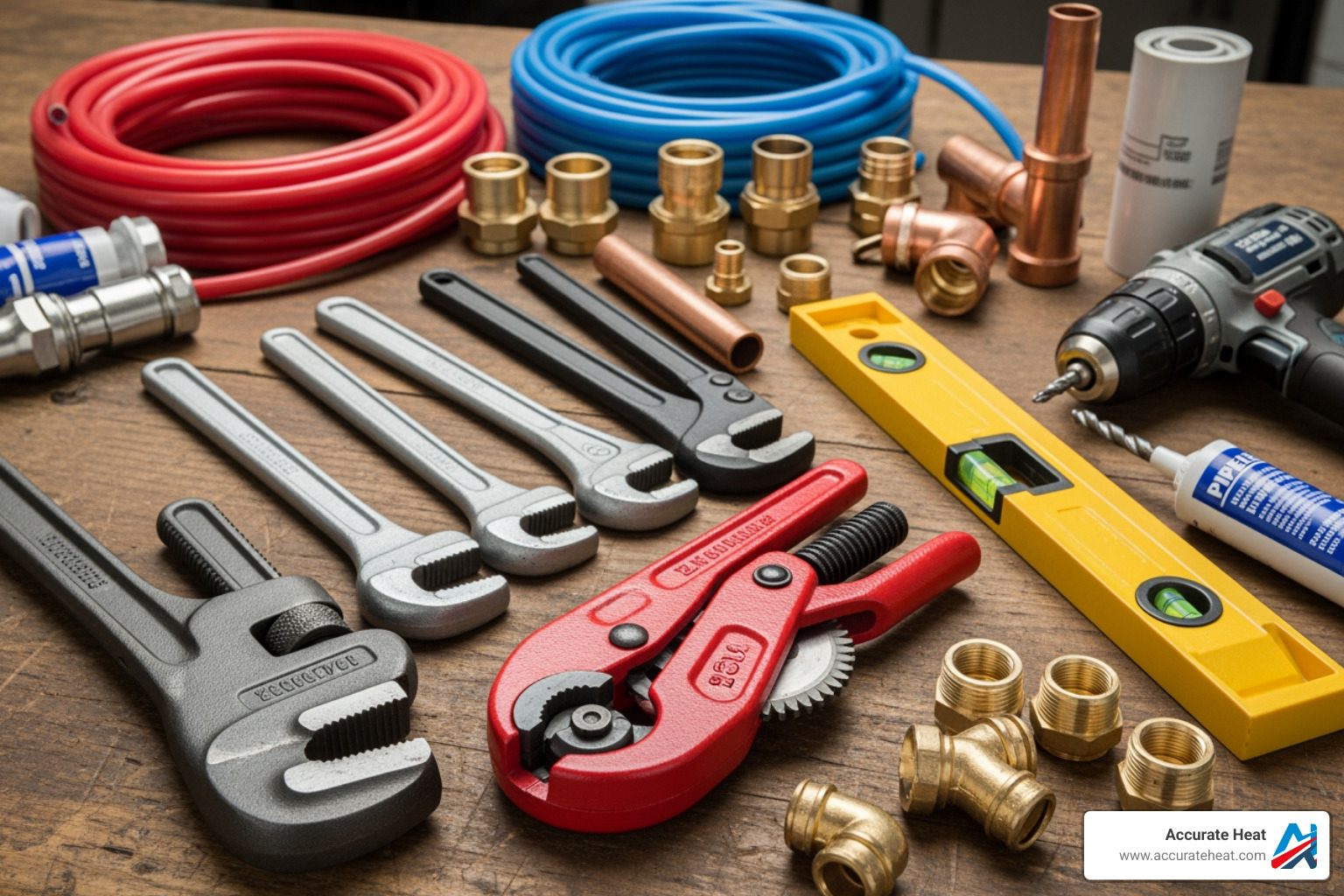
Tackling an indoor tankless water heater installation is a serious undertaking that requires specific tools and materials. Here’s what we typically use for a professional installation:
Essential Tools:
- Pipe wrenches
- Tube cutter (for copper pipes)
- Level
- Drill
- Screwdrivers (various types)
- Safety glasses and gloves (always!)
- Soldering torch and supplies (if working with copper pipes)
- Pressure test gauge (for gas lines)
- Multimeter (for electrical checks)
Potential Materials:
- Copper pipe or flexible stainless steel water lines
- Isolation valves (for hot and cold water lines, to allow easy servicing)
- Purge valves (often integrated with isolation valves, for maintenance flushing)
- Temperature and Pressure Relief Valve (T&P Valve)
- Gas piping (threaded black iron pipe or CSST, sized appropriately)
- Gas shutoff valve and sediment trap
- Venting kit (stainless steel for most gas units, PVC for high-efficiency condensing gas units)
- Heat-resistant silicone sealant and hose clamps (for venting)
- Thread sealant specifically designed for gas lines
- Electrical wire (appropriate gauge for the unit’s amperage) and circuit breaker
- Mounting hardware (screws, anchors)
- Expansion tank (if your water system has a check valve on the supply line)
- Condensate neutralizer (for high-efficiency gas units that produce acidic condensate)
Having these on hand ensures a smooth process, but more importantly, helps us perform the installation safely and to code.
The Step-by-Step Indoor Tankless Water Heater Installation Process
An indoor tankless water heater installation is a complex process. Each step requires precision and adherence to safety protocols. While we provide this detailed walkthrough, we always emphasize that this is a job best left to licensed professionals in Massachusetts, like our team at Accurate Heat.
Step 1: Removing the Old Tank Water Heater
Before we can install your new tankless unit, the old tank water heater needs to go. This involves several critical safety steps:
- Shut Off Utilities: We begin by turning off the water supply to the water heater. Then, we shut off the gas supply (if it’s a gas unit) at the main valve or turn off the electricity at the breaker panel (for electric units). Safety first!
- Drain the Tank: We connect a heat-rated hose to the drain valve at the bottom of the tank and run it to a floor drain or outside. Opening a hot water faucet in your home helps release pressure and allows the tank to drain faster.
- Disconnect Lines: Once drained, we disconnect the water lines (hot and cold) from the top of the unit. For gas units, we carefully disconnect the gas line, which typically includes a union fitting for easier removal.
- Remove and Dispose: We then move the old, heavy tank. Proper disposal is essential and must comply with local codes and regulations in Massachusetts. Many municipalities have specific requirements for recycling or disposing of old appliances.
Step 2: Mounting the New Unit and Preparing Vents
With the old unit out of the way, we prepare for the new indoor tankless water heater installation:
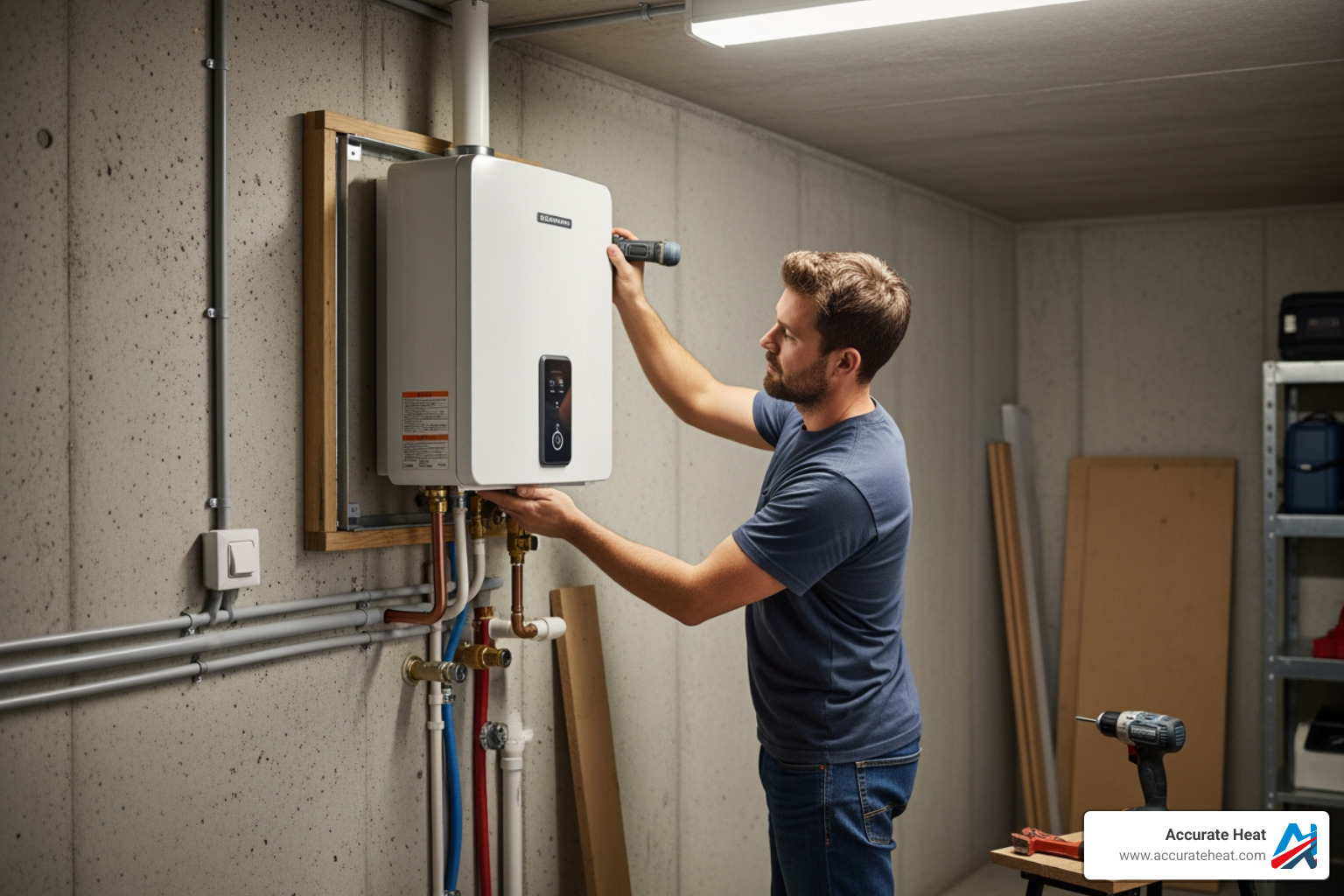
- Select Mounting Location: We re-confirm the chosen location, ensuring it meets all clearance requirements and has adequate wall strength to support the unit. Tankless units are typically mounted about four inches out from the wall.
- Mount the Unit: Using the manufacturer’s template, we securely mount the unit to wall studs. This ensures stability and safety.
- Prepare Venting: For gas tankless water heaters, proper venting is paramount. These units are “direct-vent only,” meaning they draw combustion air from outside and exhaust combustion gases directly outside. Their flue gas temperature is too low to vent through a conventional masonry chimney, so we typically vent them through a rim joist or an exterior wall.
- We drill the necessary holes for the vent pipes.
- We use approved venting materials—stainless steel for most gas units or PVC for high-efficiency condensing units.
- The vent pipes are installed with a slight upward slope (e.g., 1/4 inch per foot) away from the unit to ensure proper drainage of any condensate. Maximum vent lengths and the number of elbows must adhere to manufacturer specifications, as these can significantly impact performance.
Step 3: Connecting Water and Safety Valves
Connecting the water lines and safety features is a crucial step in the indoor tankless water heater installation:
- Connect Water Lines: We connect the cold water supply line to the inlet of the tankless unit and the hot water outlet to your home’s hot water distribution system. We use either flexible stainless steel connectors or solder copper pipes, ensuring all connections are watertight.
- Install Isolation and Purge Valves: We install isolation valves on both the hot and cold water lines leading to the unit. These valves allow us to easily shut off water to the tankless heater for maintenance without affecting your home’s main water supply. Often, these valves include integrated purge valves, which are essential for flushing the system during annual maintenance.
- Install T&P Valve: A Temperature and Pressure Relief Valve (T&P Valve) is a critical safety device. We install this on the hot water outlet, as required by code in Massachusetts. This valve releases water if the temperature or pressure inside the unit exceeds safe limits, preventing dangerous conditions.
- Expansion Tank: If your home’s water system has a check valve or anti-siphon valve on the supply line, we may also install an expansion tank near the cold intake. This helps manage pressure fluctuations within the plumbing system.
For any complex plumbing needs during your indoor tankless water heater installation, our licensed plumbers are ready to assist. Find more info about plumbing services in ma on our website.
Step 4: Connecting Gas or Electric Lines
This step varies significantly depending on whether you’re installing a gas or electric tankless water heater.
For Gas Tankless Water Heaters:
- Gas Line Sizing: Gas tankless units require a much higher BTU input (90K to 130K BTU/H) compared to traditional tank heaters (around 30K BTU/H). This often means we need to upgrade your existing gas line, potentially from a 1/2-inch to a 3/4-inch or even a 1-inch line, to ensure adequate gas flow. We’ll have your local gas company check your gas meter to determine if any updates are needed.
- Gas Line Installation: We install a gas shutoff valve directly on the gas supply connection near the unit. We then connect the gas piping (typically threaded black iron pipe) from your main gas line to the unit. If required by local code, we also install a sediment trap to catch debris before it enters the heater.
- Leak Testing: Once all gas connections are made, we use a pressure test gauge to test the line for leaks before turning on the gas. We also apply a soapy solution to all connections; any bubbles indicate a leak that must be fixed immediately.
For Electric Tankless Water Heaters:
- Dedicated Circuit: Electric tankless water heaters require a dedicated 240V circuit. This means the unit will have its own circuit breaker in your electrical panel and cannot share a circuit with other appliances.
- Breaker Size and Wire Gauge: These units draw significant amperage. We ensure your electrical panel can support the load and use the correct breaker size and wire gauge as specified by the manufacturer and local electrical codes. For higher kW units, this may involve multiple dedicated circuits and larger service wires. For example, an 8kW unit might need one 40 AMP breaker with 8 AWG wire, while a 36kW unit could require four 40 AMP breakers with four 8 AWG wires. Each set of wires must connect to its own individual double-pole breaker.
- Wiring: We connect the electrical supply wires according to the manufacturer’s wiring diagram, ensuring proper grounding. For 240-volt units, the white wire attaches to one hot terminal (L1) and the black wire to the other hot terminal (L2), with the ground wire going to the grounding screw. For 120-volt units, the white supply wire twists to the white wire in the unit, and the black to the black.
Step 5: Final Connections and Startup
The last stage of your indoor tankless water heater installation brings everything together:
- Connect Exhaust Vent: For gas units, we finalize the exhaust vent connection. This involves applying heat-resistant silicone sealant to the vent shaft, slipping on connectors, securing with hose clamps, and attaching sections of approved vent pipe. We ensure all sections are securely connected with retaining rings and tabs. For exterior wall penetrations, we use a vent thimble and seal around it with silicone caulk to prevent drafts and moisture intrusion.
- Purge Air from Water Lines: Before turning on any power or gas, we slowly open the main water valve to pressurize the system. We then open several hot water faucets in the house and run water through the unit for at least 2-3 minutes. This purges all air from the water lines and the heater itself, preventing potential damage to heating elements (especially for electric units) or ignition issues.
- Check for Leaks: We carefully check all water and gas connections for any signs of leaks.
- Power On: We then plug in the unit (for indoor electric models) or turn on the circuit breaker (for hardwired units).
- Turn on Gas: For gas units, we slowly open the gas shutoff valve.
- Set Temperature and Adjust Settings: Finally, we power on the unit and set the desired water temperature. Most units allow settings between 98°F (37°C) and 160°F (71°C), with 120°F (49°C) often recommended for safety, particularly in homes with children or elderly residents. If your home is at a higher altitude, or if your vent run is particularly long, we may need to adjust DIP switches on the unit to optimize performance and efficiency according to manufacturer specifications.
- Insulate Hot Water Pipes: We recommend insulating the hot water pipes coming directly from the water heater to further improve efficiency.
Why Professional Installation is Highly Recommended
While a DIY approach is tempting, the complexity and risks of an indoor tankless water heater installation make professional service the safest choice.
We at Accurate Heat understand the desire to save money, but with something as critical as your home’s hot water system, especially one involving gas, electricity, and ventilation, cutting corners can lead to serious consequences.
Safety, Codes, and Warranty Protection
The primary reason we strongly recommend professional installation is safety. An indoor tankless water heater installation involves several potential hazards:
- Gas Leak Hazards & Carbon Monoxide Risks: Improper gas line connections can lead to dangerous gas leaks. Furthermore, incorrect venting can cause deadly carbon monoxide to build up in your home. Gas tankless water heaters must be vented directly to the outside, and the flue gas temperature is too low for a traditional chimney. Our licensed technicians are trained to ensure all gas connections are secure and venting is installed perfectly to prevent these risks.
- Electrical Shock Dangers: Working with 120V or 240V electrical circuits carries a significant risk of electrical shock if not handled correctly. Proper wire sizing, breaker installation, and grounding are non-negotiable.
- Scalding Risk: Incorrect temperature settings or faulty T&P valves can lead to dangerously hot water, posing a scalding risk, especially for children or the elderly.
- Adhering to Local Codes: In Massachusetts towns like Franklin, Norfolk, or Medway, there are strict local plumbing and electrical codes that must be followed. Most cities and counties require a permit before installing a new water heating system. Failure to comply can result in fines, require costly re-work, and even void your home insurance.
- Warranty Protection: Most manufacturers stipulate that their tankless water heaters must be installed by a licensed professional to maintain the warranty. An improper installation can void your warranty, leaving you responsible for costly repairs.
- Proper Disposal: Even the disposal of your old water heater needs to comply with local regulations.
For any plumbing emergency, including issues arising from improper water heater installation, our team provides massachusetts emergency plumbing available 24/7 for your needs.
The True Cost of Installation
When considering an indoor tankless water heater installation, it’s important to look beyond the unit’s price tag. The typical cost for tankless water heater installation runs $1,200–$3,500, with most homeowners spending about $2,800. Professional installation usually adds $500–$1,500 more to this total.
However, this doesn’t always include the cost of potential utility upgrades. If your gas line needs to be upsized or your electrical panel requires an upgrade to accommodate the new unit, these costs can add several hundred to a few thousand dollars more.
While the upfront cost might seem higher than a traditional tank heater, tankless units offer significant long-term savings through increased energy efficiency (up to 34% more efficient) and a longer lifespan (15-20 years vs. 8-12 years for tank heaters). Investing in professional installation ensures these long-term benefits are realized and prevents costly mistakes that could reduce efficiency, create safety hazards, or require expensive repairs down the line.
We believe in providing affordable plumbing services in massachusetts without compromising on quality or safety.
Frequently Asked Questions about Indoor Tankless Heaters
How long do tankless water heaters last and what maintenance is required?
Tankless water heaters are known for their longevity! With proper care and regular maintenance, they can last 15–20 years, which is significantly longer than the typical 8-12 year lifespan of a traditional tank water heater.
The most crucial maintenance requirement is annual flushing (also known as descaling). This process removes mineral buildup, especially important in Massachusetts homes with hard water (water hardness above 7 grains per gallon can lead to scale buildup). Neglecting flushing can lead to reduced efficiency, decreased hot water output, and even damage to the heat exchanger, potentially voiding your warranty.
Beyond flushing, we also recommend inspecting filters and vents regularly. While some homeowners opt to perform basic maintenance themselves, professional servicing is recommended annually. Our technicians can check for diagnostic codes, ensure all components are functioning optimally, and perform thorough cleaning to keep your unit running efficiently for years.
Will my tankless water heater work during a power outage?
This is a common question, and the answer is generally no. Even gas-fired tankless water heaters require electricity to operate. They need power for their electronic controls, to ignite the gas burner, and to run internal fans and pumps. Electric tankless models, of course, rely entirely on electricity to heat the water.
So, during a power outage, both gas and electric tankless units will not be able to provide hot water. If you live in an area prone to power outages and continuous hot water is a priority, you might consider a small backup generator that can power the water heater’s electrical components.
How long does it take to get hot water at the faucet?
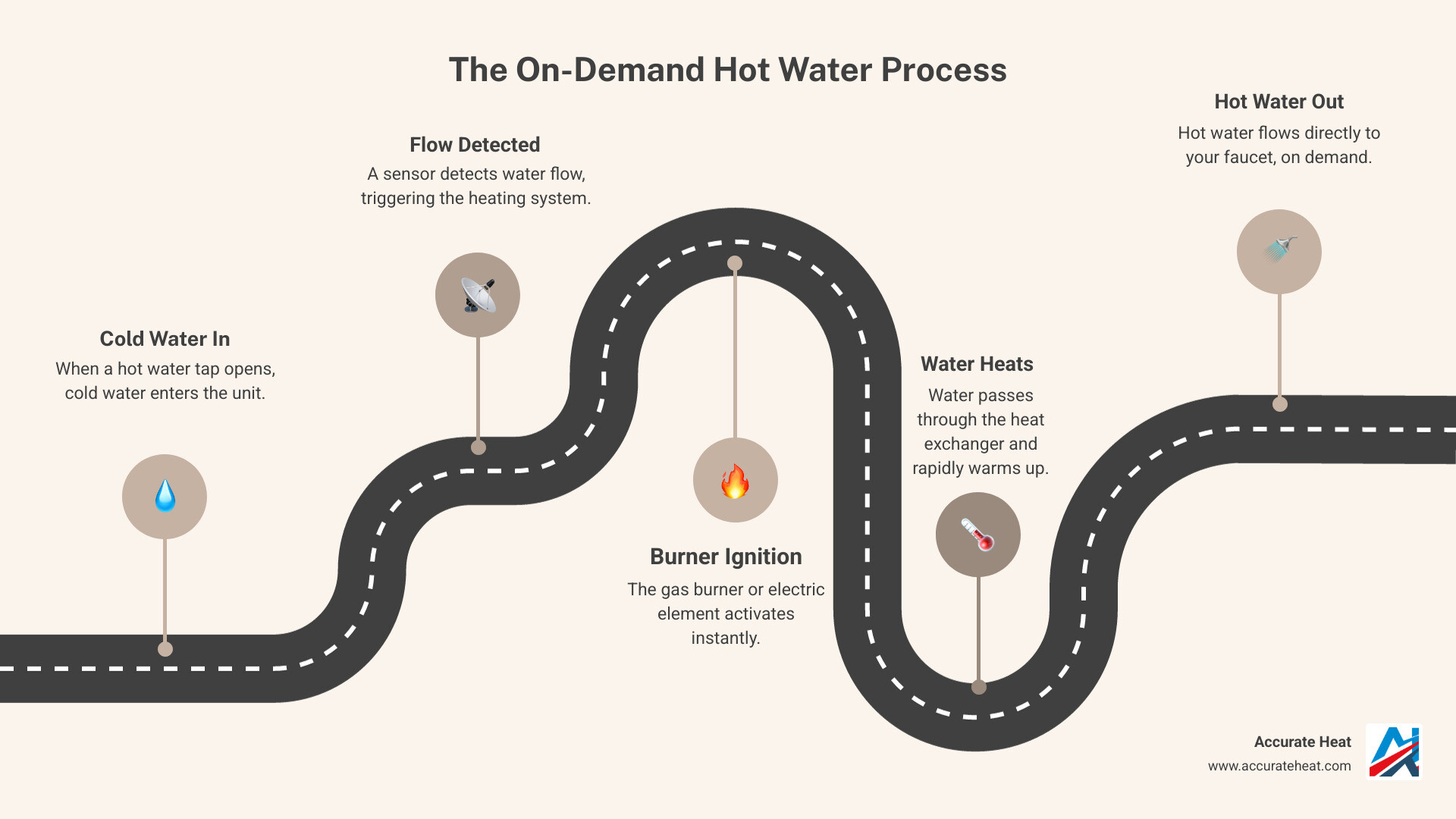
While tankless water heaters provide “on-demand” hot water, this doesn’t mean instant hot water at the tap if the unit is located far away. The unit heats water instantly as it flows through, but it still takes time for that newly heated water to travel through the pipes from the water heater to your faucet. This is the same wait you’d experience with a traditional tank heater.
The duration of this wait depends on the distance between the tankless unit and the faucet, as well as the diameter of your plumbing pipes. For those who want to minimize this wait, especially at distant fixtures, a recirculation pump can be installed. This system circulates hot water through your pipes, keeping it readily available at the tap. This would involve installing a crossover valve at the furthest plumbing fixture.
Your Journey to Endless Hot Water Ends Here
Upgrading to a tankless water heater is a smart investment in your home’s efficiency, comfort, and even its value. Imagine never running out of hot water, enjoying lower energy bills, and reclaiming valuable space previously occupied by a bulky tank.
However, as we’ve explored, the indoor tankless water heater installation process is complex. It involves intricate plumbing, precise gas line work, specialized venting, and electrical connections that must meet strict safety codes and manufacturer specifications. Attempting this as a DIY project can lead to significant safety risks, costly mistakes, and the potential to void your warranty.
For a safe, compliant, and worry-free indoor tankless water heater installation in Massachusetts—from Franklin to Worcester, and every town in between—trust the certified experts at Accurate Heat. Our team has over 30 years of experience providing reliable HVAC and plumbing services, ensuring your system is installed correctly for years of dependable, on-demand hot water.
Learn more about our tankless water heater services or contact us today to schedule a consultation and start your journey to endless hot water.