Say Goodbye to Cold Showers: An Introduction
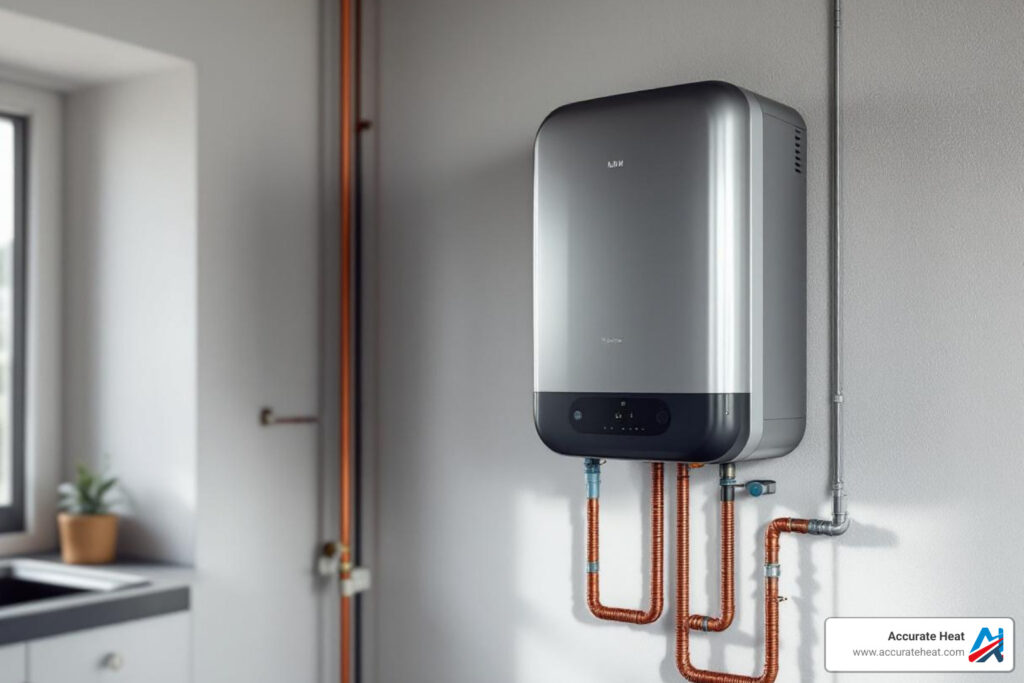
Tankless water heaters provide hot water on demand by heating water as it flows through the unit, rather than storing it in a tank. They offer endless hot water, significant energy savings, and a longer lifespan than traditional models.
Quick Facts:
- How They Work: Heat water instantly as it flows through a heat exchanger
- Energy Savings: 24-34% more efficient for homes using 41 gallons or less daily
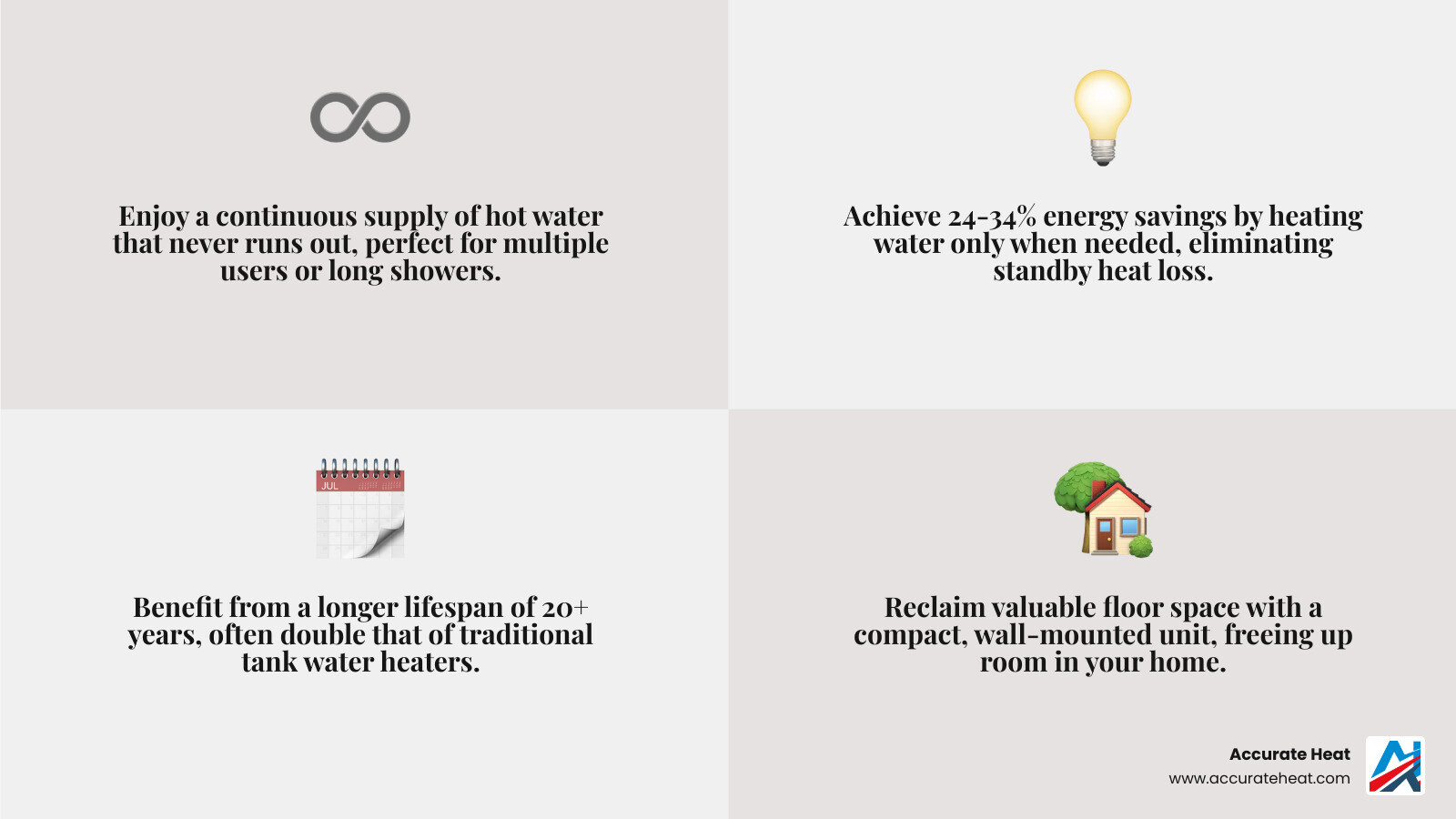
- Lifespan: 20+ years vs. 10-15 years for tank models
- Space: Wall-mounted units free up valuable floor space
- Supply: Continuous hot water (but flow rate is limited by GPM)
Imagine instant hot water that never runs out—no more scheduling showers or waiting for a tank to reheat. That’s the reality with tankless water heaters.
These compact, wall-mounted units heat water only when you need it, eliminating the standby heat loss common with traditional tanks. The result is lower energy bills, more space in your utility room, and hot water that flows as long as you need it.
For Massachusetts homeowners, the energy efficiency of tankless systems translates to significant savings. While the upfront cost is higher, lower operating costs and a much longer lifespan make them a smart long-term investment.
However, tankless water heaters aren’t one-size-fits-all. Choosing the right unit requires understanding your hot water demand, gas vs. electric models, and proper sizing. This guide walks you through everything you need to know.
How On-Demand Water Heaters Work
At their core, tankless water heaters operate on a simple principle: they only heat water when there’s a demand for it. This is the secret to their efficiency and endless hot water supply.
When you turn on a hot water faucet, cold water flows into the tankless water heater. A sensor detects this flow and activates the heating system—either a powerful gas burner or robust electric elements. The water rapidly heats as it passes through a heat exchanger, reaching your desired temperature before traveling to the faucet. When you turn the tap off, the sensor signals the unit to shut down, returning it to a dormant, energy-saving state.
This on-demand process provides a continuous supply of hot water and eliminates standby heat loss, the energy wasted by traditional tanks that constantly reheat stored water. This fundamental difference is why tankless water heaters are so energy-efficient and can be left on, ready to work only when needed.
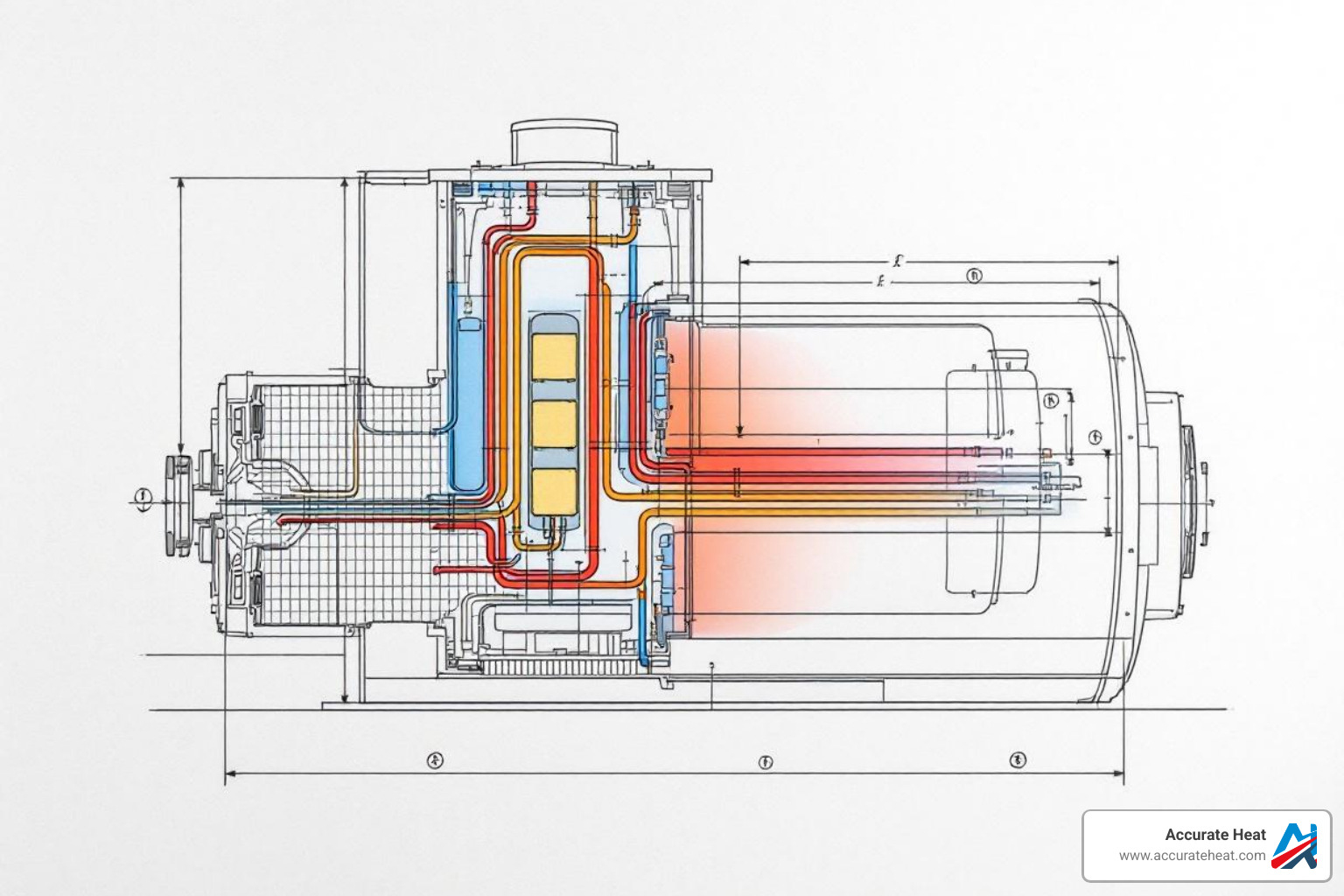
This on-demand operation means that tankless water heaters don’t consume energy unless there’s an actual call for hot water. You can confidently leave your tankless water heater on all the time, knowing it’s only working when needed.
For a deeper dive into how these systems revolutionize hot water delivery, you can explore resources like the Department of Energy’s explanation on How demand-type water heaters work.
Understanding Energy Efficiency
For Massachusetts homeowners, a major draw of tankless water heaters is superior energy efficiency. This is measured by the Uniform Energy Factor (UEF); a higher UEF means greater efficiency and lower operating costs. Many tankless water heaters are also ENERGY STAR certified, meeting strict EPA guidelines that guarantee savings.
Condensing tankless water heaters are the most efficient type. They use a secondary heat exchanger to capture additional heat from exhaust gases that non-condensing units waste. This not only boosts efficiency (with UEF ratings up to 0.96) but also allows for less expensive PVC venting.
While the upfront cost for a tankless water heater is higher, the energy savings add up. Homes using about 41 gallons of hot water daily can improve efficiency by 24% to 34%. For higher usage (up to 85 gallons daily), savings range from 8% to 14%. These savings mean lower monthly utility bills, making it a smart investment for your wallet and the environment.
Our team at Accurate Heat is committed to helping you make greener choices for your home, and we offer services and advice on Tips for a Greener Plumbing System.
Choosing the Right Unit: A Buyer’s Guide
Selecting the perfect tankless water heater for your home in Franklin, MA, involves more than picking a model off the shelf; it’s about matching the technology to your needs. Sizing is paramount. While tankless water heaters offer a continuous supply, their capacity is measured by flow rate (GPM) and the temperature rise they can achieve. An undersized unit will struggle to provide hot water when multiple fixtures are running.
To size a unit correctly, we analyze your household’s hot water demand, including how many people live in your home and which appliances you run simultaneously. We also factor in Massachusetts’ cold climate, as colder groundwater requires the heater to work harder, reducing its effective GPM. Ensuring the unit can handle your peak simultaneous use is key to satisfaction.
To help you steer these choices, the Department of Energy provides excellent guidance on Selecting a New Water Heater.
Types of Tankless Water Heaters
Tankless water heaters are primarily differentiated by their energy source: gas or electric. Each has its own considerations for installation, performance, and operating costs.
Gas Tankless Water Heaters
These units use natural gas or propane and are generally more powerful, offering higher flow rates (GPM). This makes them a popular choice for whole-home applications in larger households.
- Propane vs. Natural Gas: Your choice depends on local availability. Natural gas is piped to the home, while propane requires a storage tank. Performance is similar, but fuel costs can differ.
- Power Requirements: Gas models need a sufficiently sized gas line (often larger than for a tank heater) and a small electrical connection for the controls.
- Venting Needs: Combustion byproducts must be safely vented outside. Non-condensing units require specialized stainless steel, while high-efficiency condensing models can use less expensive PVC.
Electric Tankless Water Heaters
Electric models are smaller and don’t require venting, making them easier to install. However, they typically have lower GPM outputs and require a substantial electrical circuit.
- Power Requirements: These units demand significant electricity, often needing dedicated high-amperage circuits (240V). This may require an electrical panel upgrade in older homes.
- Installation: Their compact size and lack of venting make them suitable for point-of-use applications or smaller homes with modest hot water needs.
Whole-Home vs. Point-of-Use Models
Most units we discuss are whole-home models. However, smaller point-of-use tankless water heaters can be installed at a specific faucet to provide instant hot water without the wait.
Here’s a quick comparison of Gas vs. Electric Tankless Water Heaters:
| Feature | Gas Tankless Water Heaters | Electric Tankless Water Heaters |
|---|---|---|
| Fuel Type | Natural Gas or Propane | Electricity |
| Initial Cost | Often higher due to complex venting and gas line requirements | Generally lower, but electrical upgrades can increase costs |
| Installation | Requires gas line, venting, and electrical connection | Requires dedicated high-amperage electrical circuit, no venting |
| Performance | Higher GPM, better for whole-home and high demand | Lower GPM, better for point-of-use or smaller households |
| Operating Cost | Typically lower in Massachusetts due to gas prices | Can be higher in Massachusetts depending on electricity rates |
| Efficiency | High UEF, especially for condensing models (up to 0.98) | High efficiency in converting electricity to heat (nearly 100%) |
| Size | Compact, wall-mounted | Very compact, often smaller than gas units |
Our team can help you determine the best fit for your home and lifestyle.
Key Sizing Factors for your tankless water heaters
Properly sizing your tankless water heater is the most critical step. We consider three main factors: Flow Rate (GPM), Temperature Rise, and heating capacity.
Flow Rate (GPM – Gallons Per Minute): This measures how many gallons of hot water the unit can deliver per minute. To determine your need, estimate your peak demand by adding up the GPM of fixtures you’ll use simultaneously.
Common Appliance Flow Rates:
- Shower: 2.0 – 2.5 GPM
- Kitchen Faucet: 1.5 – 2.2 GPM
- Bathroom Sink Faucet: 0.5 – 1.5 GPM
- Dishwasher: 1.0 – 2.0 GPM (intermittent)
- Washing Machine: 1.5 – 3.0 GPM (intermittent)
For example, running a shower (2.5 GPM) and a dishwasher (1.5 GPM) at the same time requires a tankless water heater capable of at least 4.0 GPM.
Temperature Rise: This is the difference between the incoming cold water temperature and your desired hot water output (typically 120°F). In Massachusetts, winter groundwater can be as low as 40°F, requiring an 80°F temperature rise. A unit’s GPM rating decreases as the required temperature rise increases, making this a crucial factor in our climate.
Heating Capacity (BTU for Gas, kW for Electric):
- BTU (British Thermal Units): Gas tankless water heaters are rated in BTUs, with high-demand units ranging from 120,000 to 200,000 BTU/h. This high capacity allows them to heat water instantly.
- Kilowatts (kW): Electric tankless water heaters are rated in kW (commonly 11kW to 36kW). A higher kW rating means more hot water production but requires a larger electrical service.
We always recommend a professional assessment to ensure your tankless water heater is perfectly sized.
Advanced Features and Benefits
Modern tankless water heaters come with advanced features for convenience, safety, and comfort.
- Wi-Fi Connectivity and Smart Home Integration: Many modern units, like those from Rheem and Navien, offer Wi-Fi control. This allows you to adjust temperatures, track energy usage, and receive maintenance alerts from your smartphone.
- Digital Displays: Intuitive digital screens provide real-time data on temperature, flow rate, and error codes, simplifying system monitoring and diagnostics.
- Freeze Protection: A critical feature for Massachusetts, this system automatically activates to prevent internal pipes from freezing and bursting during cold weather.
- Leak Detection Systems: Advanced models can detect leaks, alert you, and even shut off the water supply automatically to prevent costly water damage.
- Recirculation Pumps: To deliver hot water faster and eliminate the “cold water sandwich,” some tankless water heaters have built-in recirculation pumps (like Rinnai’s Smart-Circ™ Intelligent Recirculation™ technology) that learn your usage patterns. This feature can also be added to other models.
Installation and Maintenance for Your Tankless Water Heater
Ensuring your tankless water heater‘s performance and longevity hinges on professional installation and regular maintenance.
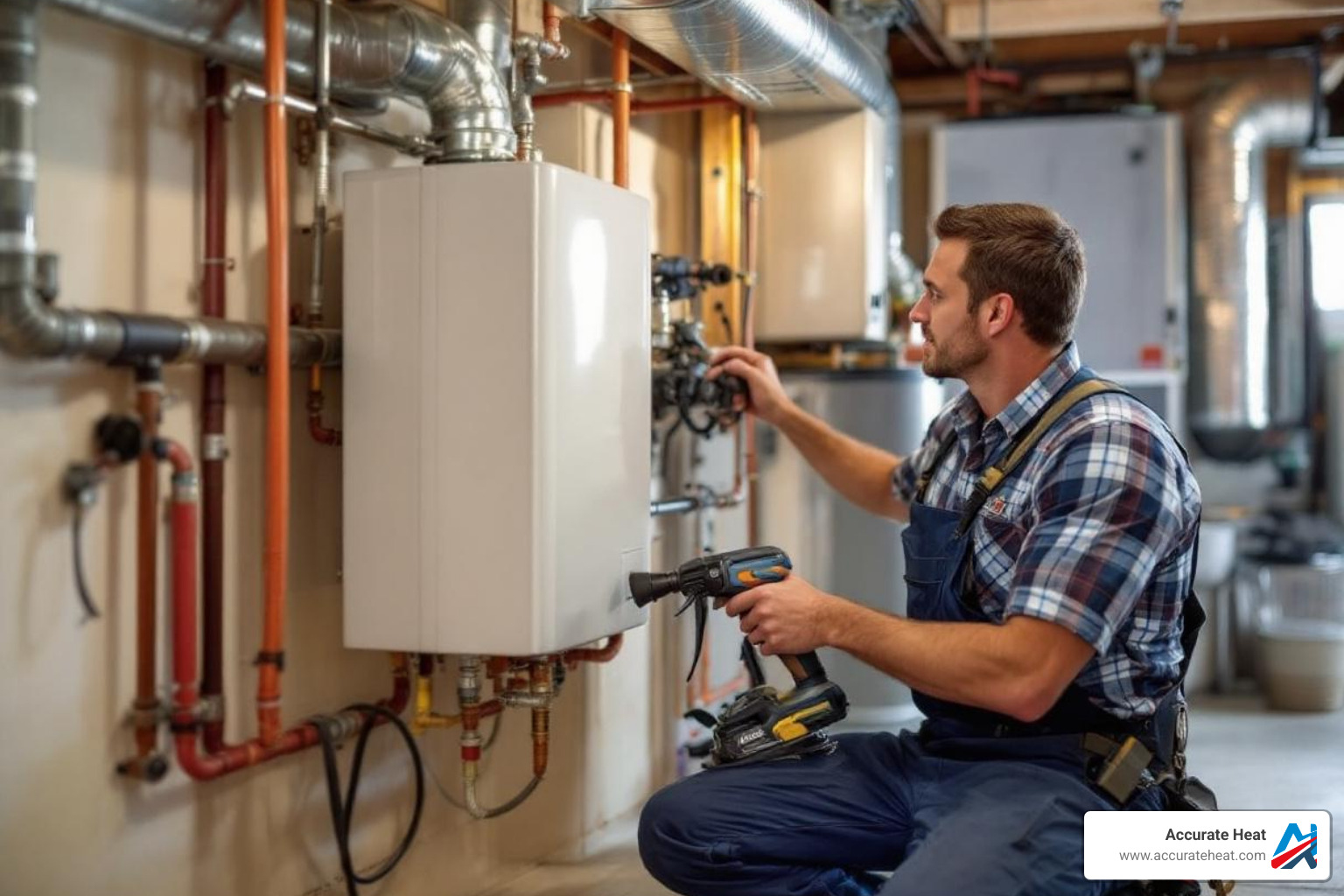
The Professional Installation Process
Tankless water heaters have complex installation requirements, making professional installation essential for safety, efficiency, and code compliance in Massachusetts.
- Venting Requirements: Gas units must be vented to safely expel exhaust. Condensing models can use PVC, while non-condensing units require stainless steel. Proper installation by a pro is essential for safety.
- Gas Line Upgrades: Tankless water heaters need more fuel than tank models, often requiring an upgrade to a larger gas line to ensure proper performance.
- Electrical Circuit Needs: Gas models need a standard outlet for controls. Electric tankless water heaters require dedicated high-amperage circuits, which may mean upgrading your electrical panel.
- Water Connections: Proper connections are key. We install isolation valves (“flush kit” valves) to make future maintenance simple and effective.
- Importance of Professional Service: Due to the complex gas, electrical, and venting work, professional installation is non-negotiable. Our team at Accurate Heat has over 30 years of experience providing Water Heater Installation Services in MA, ensuring a safe and compliant installation.
Essential Maintenance Requirements
While durable, tankless water heaters require regular maintenance to reach their 20+ year lifespan, especially in areas with hard water.
- Annual Flushing and Descaling: The most important task is flushing the unit annually to remove mineral scale buildup, which harms efficiency and can cause damage. The “flush kit” installed by a pro makes this process easy.
- Inlet Filter Cleaning: The inlet water filter should be checked and cleaned periodically to prevent sediment from clogging the unit and restricting flow.
- Professional Inspection: An annual inspection by a technician is recommended to check connections, test safety features, and catch minor issues before they become major problems.
Proper maintenance extends the life of your tankless water heater and keeps it operating at peak efficiency. For comprehensive care, consider our advice on Why Regular Plumbing Maintenance is a Must in Massachusetts.
Frequently Asked Questions about Tankless Water Heaters
Here are answers to common questions from Massachusetts homeowners about tankless water heaters.
Can a tankless unit keep up with a large family’s needs?
Yes, as long as it’s sized correctly. A whole-home tankless water heater can easily outperform a traditional tank by providing continuous hot water for multiple simultaneous uses. Unlike a 40-gallon tank that can run empty, a properly sized tankless water heater meets your family’s peak demand. The key is to choose a unit with a GPM (Gallons Per Minute) rating that matches the combined flow rate of all appliances you might run at once. For very large homes, two units can be installed in parallel to guarantee an abundant supply.
How much can I really save with a tankless water heater?
The savings are significant. By eliminating standby heat loss (the energy wasted keeping a tank of water hot), tankless water heaters are much more efficient. According to the U.S. Department of Energy, homes using 41 gallons or less of hot water daily can see 24% to 34% more energy efficiency. For homes with higher usage (up to 85 gallons daily), savings still range from 8% to 14%. These savings, combined with a longer lifespan, make tankless water heaters a smart long-term investment that lowers your monthly utility bills.
What is the expected lifespan of a tankless water heater?
A tankless water heater can last 20 years or more—roughly double the lifespan of a traditional 10-15 year tank heater. Their longevity comes from a superior design. Since they don’t store water, they aren’t prone to the internal corrosion that causes tank failure. Additionally, most parts in a tankless water heater are replaceable, so a single failed component doesn’t require replacing the entire unit. With proper annual maintenance, like descaling, your investment is protected for decades.
Upgrade to Endless Hot Water Today
As we’ve explored, tankless water heaters offer a compelling upgrade for any home. From the simple yet effective mechanism of on-demand heating to the significant energy savings and impressive longevity, they represent a modern solution to an age-old problem: the desire for an abundant and efficient hot water supply.
The key takeaways are clear: you’ll never run out of hot water, you’ll save on energy bills, you’ll free up valuable space in your home, and your investment will last for two decades or more. While the upfront cost might be higher than a traditional tank, the long-term value, improved comfort, and environmental benefits make it a worthwhile decision for homeowners in Massachusetts.
Ready to say goodbye to cold showers and accept the convenience and efficiency of tankless water heaters? Our team at Accurate Heat, with over 30 years of experience serving Franklin, MA, and surrounding communities like Norfolk, Medway, Medfield, and Bellingham, is here to help. We provide expert advice, professional installation, and reliable maintenance services to ensure your transition to endless hot water is seamless.
Contact us today for a consultation or to Get a quote for Tankless Water Heater Services custom to your home’s unique needs. Let us help you upgrade your home comfort.