Understanding Home Comfort Systems: The Foundation of Year-Round Indoor Comfort
Home comfort systems integrate heating, cooling, ventilation, and air quality components to maintain optimal indoor conditions throughout the year. These systems—commonly called HVAC (Heating, Ventilation, and Air Conditioning)—work together to keep your home warm in winter, cool in summer, and healthy year-round.
Quick Overview: What Home Comfort Systems Include
- Thermostat – Controls temperature and system operation
- Heating Equipment – Furnaces, boilers, or heat pumps for winter warmth
- Cooling Equipment – Air conditioners or heat pumps for summer comfort
- Indoor Air Quality Products – Humidifiers, air purifiers, and ventilators
- Distribution System – Ductwork or ductless units that deliver conditioned air
For Massachusetts homeowners, selecting the right home comfort system isn’t just about picking equipment—it’s about understanding how each component works together to handle our harsh winters and humid summers. Modern systems can save 15-25% more energy than standard products when properly sized and installed, making the upfront investment worthwhile for long-term comfort and lower utility bills.
The key to optimal performance lies in treating your house as an integrated system rather than a collection of separate parts. Your heating, cooling, air quality, and insulation all affect each other. A furnace that’s too large wastes energy and creates uncomfortable temperature swings. Poor ductwork undermines even the most efficient equipment. And without proper air quality management, you may have moisture problems no matter how good your HVAC system is.
This guide walks you through selecting commercial-grade home comfort systems that deliver reliable performance, especially during Massachusetts’ temperature extremes when system failures create true emergencies.
Understanding the Core Components of Home Comfort Systems
When we talk about home comfort systems, we are describing a sophisticated network of machinery designed to manage your indoor environment. Think of it as the “vital organs” of your home. If one part is struggling, the whole “body” feels it.
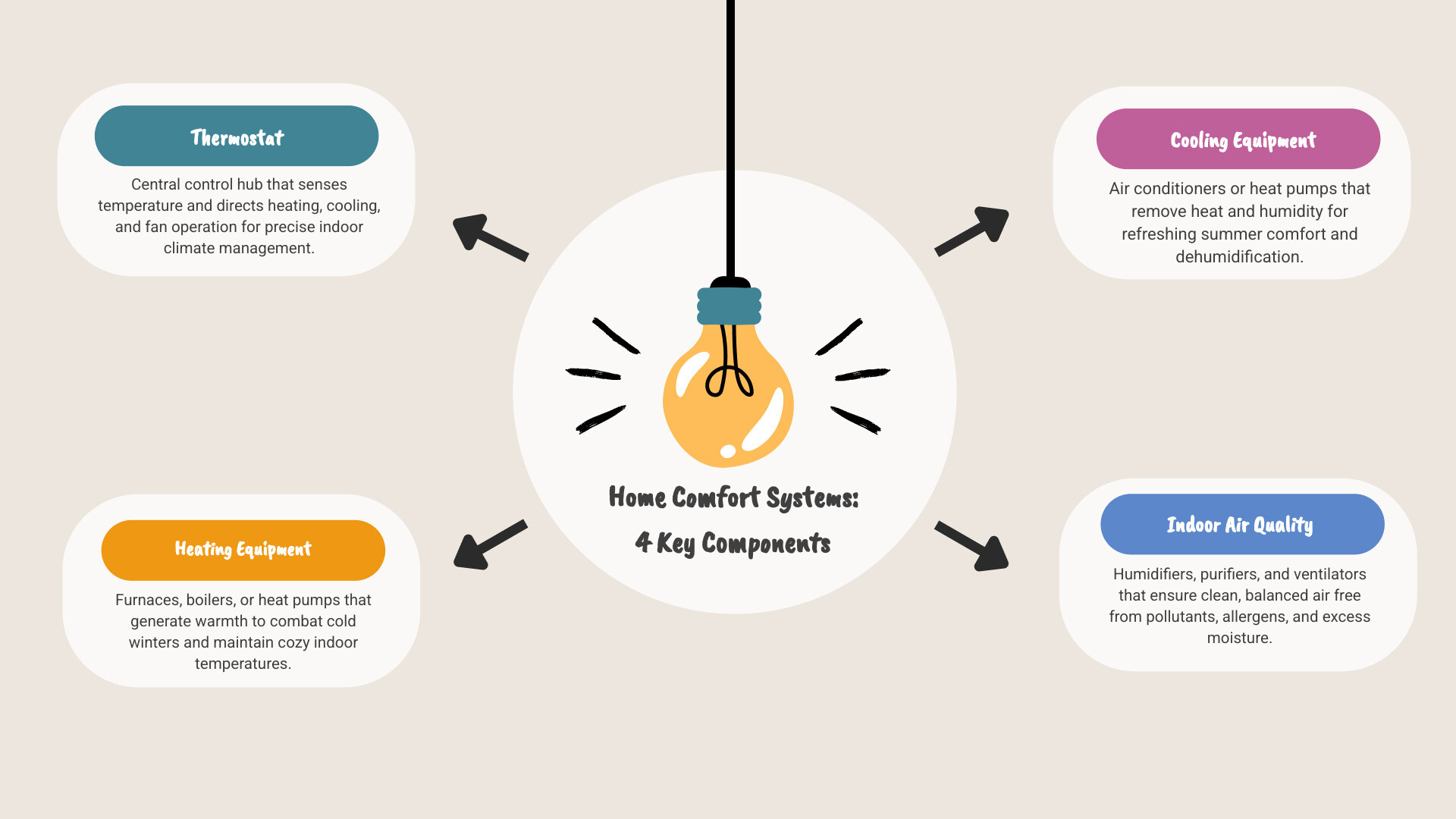
At the heart of every system are several key players:
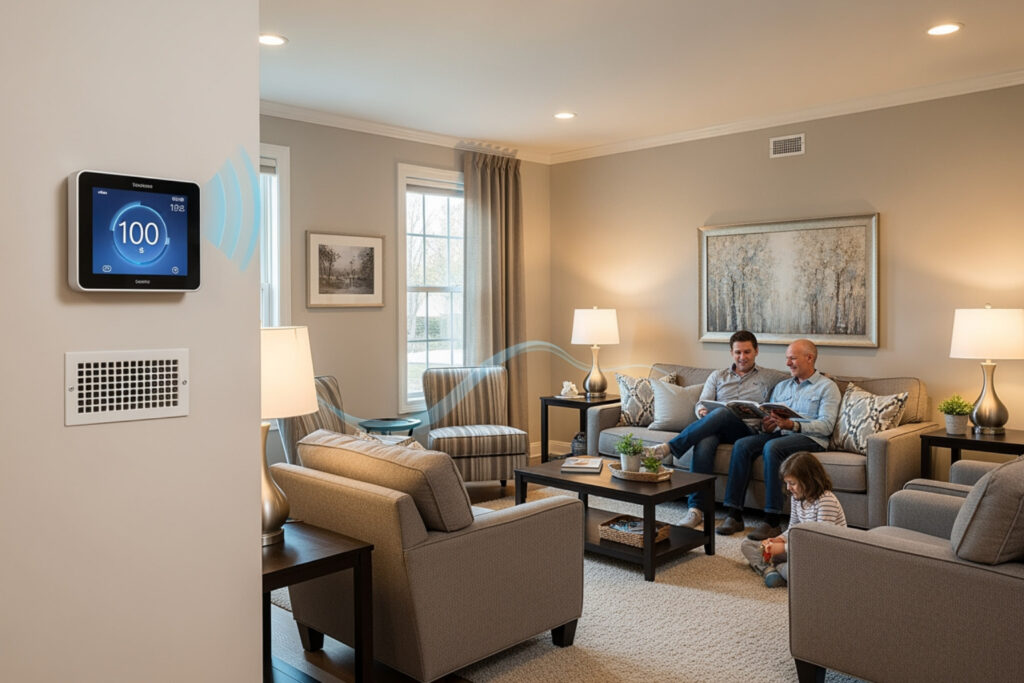
- The Thermostat: This is the brain of the operation. Modern thermostats do more than just click “on” or “off.” They monitor humidity, learn your schedule, and can even be controlled from your phone while you’re at a Patriots game.
- The Furnace or Boiler: In our neck of the woods—from Franklin to Newton—the heating element is usually the hardest worker. Furnaces heat air and blow it through ducts, while boilers heat water to provide radiant heat through pipes or radiators.
- The Air Conditioner or Heat Pump: These components manage the “C” in HVAC. While air conditioners only cool, heat pumps are the “superheroes” of the industry—they can both heat and cool by moving heat into or out of your home.
- Indoor Air Quality (IAQ): This is often the forgotten sibling of the HVAC family, but it’s crucial. IAQ products like humidifiers, air purifiers, and ventilators ensure the air you breathe isn’t just the right temperature, but also clean and properly moisturized.
According to Scientific research on home comfort, your home’s weatherization (insulation and sealing) plays a massive role in how these components perform. If your home is “leaky,” even the most expensive system will struggle to keep you cozy. For those looking to dive deeper into how these parts interact, you can find More info about HVAC services for your home on our dedicated service page.
Comparing System Types for High-Performance Residences
Not every home in Massachusetts is built the same. A historic colonial in Medfield has very different needs than a modern build in Foxboro. Choosing between different home comfort systems depends on your available space, existing ductwork, and efficiency goals.
Split Systems
The most common configuration is the “split system.” It’s called this because it’s literally split: one part is outside (the condenser or heat pump) and one part is inside (the furnace or air handler). These are great for homes with existing ductwork and provide a reliable, traditional way to manage climate.
Packaged Units
If your home lacks a basement or a dedicated mechanical closet, a packaged unit might be your best friend. These systems combine all components—heating and cooling—into one outdoor cabinet, often placed on the roof or a concrete pad. They are a “space-saver” solution that keeps the mechanical noise outside.
Hybrid Heating (Dual-Fuel)
Hybrid systems are becoming incredibly popular in Eastern Massachusetts. They combine an electric heat pump with a gas furnace. When the weather is mildly chilly, the efficient heat pump does the work. When the temperature drops into the “frozen tundra” range (below -5°F), the gas furnace kicks in to provide that intense, reliable heat. It’s the best of both worlds!
| Feature | Split System | Packaged System |
|---|---|---|
| Location | Indoor and Outdoor components | All-in-one outdoor unit |
| Best For | Homes with basements/attics | Limited indoor space / Rooftops |
| Maintenance | Standard | Generally easier access |
| Customization | Highly customizable | Limited configurations |
If you are considering an upgrade, check out More info about heat pump systems to see if a dual-fuel setup is right for your specific property.
Selecting the Right home comfort systems for Your Climate
In Massachusetts, we don’t just have weather; we have “events.” From Nor’easters to humid heatwaves, our home comfort systems must be resilient.
One of the biggest mistakes a homeowner can make is choosing a system based on “rule of thumb” estimates. An old estimate suggests one ton (12,000 Btu) of cooling for every 400 to 500 square feet. However, in a very efficient, modern house, one ton can condition up to 1,000 square feet!
We use Manual J calculations to determine the exact “load” of your home. This takes into account:
- The number of windows and their orientation.
- The type of insulation in your walls and attic.
- The local climate data for towns like Norfolk and Wrentham.
- The number of people living in the home.
An oversized system will “short cycle,” meaning it turns on and off too quickly. This doesn’t just waste energy; it fails to remove humidity, leaving you feeling clammy in the summer. It can even lead to mold and poor indoor air quality.
How Ductless Mini-Splits Enhance home comfort systems
As a Mitsubishi Electric Elite Diamond Contractor, we’ve seen how ductless mini-splits have revolutionized home comfort in Massachusetts. These systems are perfect for older homes in places like Wellesley or Belmont where installing new ductwork would be a nightmare (and a budget-buster).
Why Ductless?
- Zoned Cooling/Heating: You don’t have to heat the guest room if no one is using it. Each indoor unit can be controlled independently.
- Energy Efficiency: Since there are no ducts, you don’t lose the 20-30% of energy that typically leaks out of traditional ductwork.
- Quiet Operation: These units are whisper-quiet, making them ideal for bedrooms or home offices.
- Versatility: They are perfect for home additions, finished basements, or that one “hot room” over the garage.
Modern heat pump models can supply 100% heating capacity even when the temperature drops to -5°F, making them a viable primary heat source for many. For more details on these versatile units, see More info about ductless mini-split AC systems.
Maximizing Efficiency with Advanced Ratings and Smart Technology
Understanding efficiency ratings is like reading the nutrition label on a cereal box—it tells you exactly what you’re getting for your money. When choosing home comfort systems, keep these acronyms in mind:
- SEER (Seasonal Energy Efficiency Ratio): This measures cooling efficiency. Since 2006, all new residential ACs must have a SEER of at least 13. However, ENERGY STAR qualified units must be at least 14. Upgrading from a SEER 9 to a SEER 14 can reduce energy consumption by more than 35%!
- AFUE (Annual Fuel Utilization Efficiency): This is for furnaces. It tells you what percentage of the fuel is actually turned into heat. To earn an ENERGY STAR label, gas furnaces must have an AFUE of 90% or greater. That means only 10% of the energy is lost through the chimney.
- HSPF (Heating Seasonal Performance Factor): This measures the efficiency of a heat pump in heating mode. Look for an HSPF of 8 or higher.
- EER (Energy Efficiency Ratio): This is a “snapshot” of efficiency at a specific high temperature (usually 95°F). For room air conditioners, aim for an EER of 10 or higher.
According to the Consumer Guide to Home Heating and Cooling Fact Sheet, for every $100 you spend on cooling, switching to a high-efficiency SEER 14 system can save you up to $35 a month.
How Smart Controls Enhance home comfort systems
The most efficient equipment in the world won’t save you money if it’s running full blast when you aren’t home. This is where smart thermostats come in.
Smart controls allow for:
- Remote Monitoring: Did you forget to turn the heat down before heading to the Cape? Just use the app.
- Energy Management: Many smart thermostats provide reports on your energy usage, helping you identify where you can save.
- Geofencing: Some systems can sense when your phone is approaching the house and will start cooling or heating so it’s perfect the moment you walk through the door.
- Voice Integration: “Alexa, set the living room to 72 degrees.”
Adjusting your thermostat when you are away or sleeping can save up to 10% on your annual heating and cooling costs. In fact, you can save 1% on your heating bill for every 1°F you set back the thermostat during an eight-hour period. That’s a lot of “found money” just for being tech-savvy!
Integrating Indoor Air Quality and Maintenance for Longevity
A high-performance home comfort system isn’t just about temperature; it’s about the air you breathe. In Massachusetts, our homes are built tight to keep the cold out, but this can trap pollutants inside.
Key IAQ Components:
- Humidifiers: During a dry Massachusetts winter, a whole-home humidifier prevents itchy skin, static electricity, and protects your wood floors and furniture.
- Air Purifiers: These can remove up to 99% of allergens, dust, and pet dander from the air.
- Ventilation: Heat Recovery Ventilators (HRVs) bring in fresh outdoor air while “recovering” the heat from the air being exhausted, ensuring you aren’t just throwing money out the window.
The Power of Maintenance We cannot stress this enough: regular maintenance is the secret to system longevity. Regular maintenance can reduce your heating and cooling costs by 5% to 10% and significantly prolong the life of your equipment.
A standard maintenance visit includes:
- Cleaning or replacing filters (which you should also do yourself monthly during peak seasons!).
- Checking refrigerant levels.
- Inspecting ductwork for leaks (which can be sealed with mesh and mastic).
- Cleaning the outdoor condenser coils of debris and weeds.
- Inspecting the heat exchanger for cracks—a vital safety step!
We once saved a customer over $2,400 just by discovering their heat exchanger was still under warranty during a routine check. If your system is over 15 years old, it’s likely time to start planning for a replacement to avoid an emergency breakdown during a January freeze. For more on this, read More info about why proper maintenance is essential.
Frequently Asked Questions about Home Comfort Systems
What is the minimum SEER rating for a new system?
As of current regulations, the minimum SEER for residential air conditioners sold in the United States is 13. However, we strongly recommend ENERGY STAR qualified units, which require a SEER of 14 or higher. Upgrading to a higher SEER is one of the fastest ways to see a reduction in your monthly utility bills.
How does a hybrid heating system work?
A hybrid system (also known as dual-fuel) uses an electric heat pump for the majority of the year. Heat pumps are incredibly efficient—sometimes producing up to four times more energy than they consume. When the temperature drops below a certain point (usually around freezing or lower), the system automatically switches to a gas or oil furnace to provide the “heavy lifting” heat required for extreme Massachusetts winters.
Why is system sizing more important than BTU capacity?
Many people think “bigger is better,” but an oversized HVAC system is a nightmare. It will cool the air so fast that the thermostat shuts off before the system has a chance to remove humidity. This leads to a home that feels like a “damp cave.” It also causes “short-cycling,” which wears out the motor and compressor much faster. Proper sizing via a Manual J calculation ensures the system runs for the appropriate cycle length to maintain comfort and efficiency.
Conclusion
Navigating home comfort systems doesn’t have to be overwhelming. By focusing on high-efficiency equipment, proper sizing, and smart technology, you can create a home environment that is both comfortable and cost-effective.
At Accurate Baker Elman, we bring over 30 years of experience to every job. As a Mitsubishi Electric Elite Diamond Contractor, we specialize in the high-performance solutions that Massachusetts homes require. Whether you are in Franklin, Newton, or any of our surrounding service areas like Medfield or Walpole, we are here to ensure your system performs at its peak.
We offer 24/7 emergency service because we know that furnaces don’t always wait for business hours to quit. From plumbing emergencies to full HVAC installations, our team is dedicated to honest, expert, and timely solutions.
Ready to optimize your home’s performance? Contact our experts for HVAC and plumbing services today and let’s get your home comfort system working for you.