
The Hot Water Question Every Massachusetts Homeowner Is Asking
Are tankless water heaters better than traditional storage tank models? It’s not a simple yes or no answer. The “better” choice depends entirely on your home’s needs, your budget, and your hot water usage patterns.
Quick Answer:
- Tankless wins on: Energy efficiency (24-34% more efficient), lifespan (20+ years vs. 10-15 years), space savings, and endless hot water supply
- Traditional tank wins on: Lower upfront cost ($800-1,500 vs. $2,500-5,000 installed), simpler installation, no flow rate limitations
- The catch: Tankless has a 10-25 year payback period and can struggle with multiple simultaneous uses
- Best for tankless: Small to mid-sized households, space-constrained homes, long-term homeowners focused on efficiency
- Best for traditional: Large families with high simultaneous demand, tight budgets, homes needing quick replacement
You just did the dishes and now it’s time to shower before bed. You turn on the water, wait a minute, and—uh oh. It’s lukewarm at best. Sound familiar?
For Massachusetts homeowners, hot water isn’t just a convenience—it’s essential for surviving our harsh winters. Whether you’re replacing an aging unit or upgrading during a renovation, the tank versus tankless debate matters. Your water heater is your home’s second-largest energy expense, so getting this decision right affects both your comfort and your wallet.
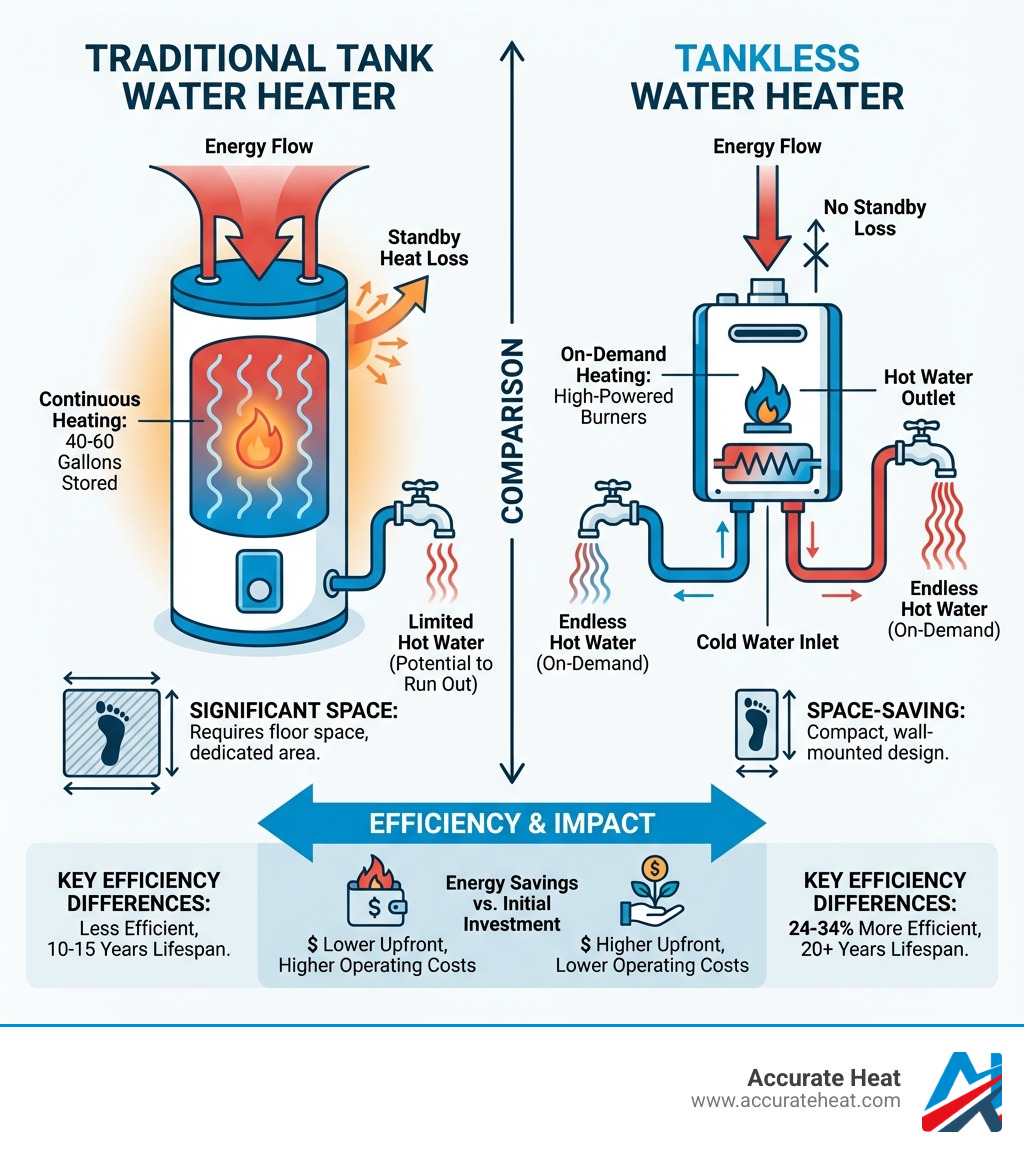
Traditional storage tank heaters have been the standard for decades. They store 40-60 gallons of hot water, constantly reheating it even when you’re not using it. Tankless water heaters, on the other hand, heat water on demand as it flows through the unit—no storage, no standby losses.
This guide breaks down the real advantages and drawbacks of each system, with specific considerations for Massachusetts homes (like our cold groundwater temperatures that impact tankless performance). By the end, you’ll know exactly which option makes sense for your situation.
The Case for Going Tankless: Efficiency and Endless Hot Water
Imagine turning on your faucet and getting an instant supply of hot water, no waiting, no running out. That’s the charm of tankless water heaters. Unlike their traditional counterparts that store and continuously heat a reservoir of water, tankless units only kick into action when you need hot water. This “on-demand” heating is the secret to their superior energy efficiency.
Traditional storage tank heaters suffer from what we call “standby heat loss.” They’re like a perpetually boiling kettle, keeping water hot even when no one’s home or asleep. This constant reheating is a significant waste of energy. Tankless water heaters eliminate these standby energy losses by heating water rapidly as it flows through the unit, using high-powered burners (for gas models) or electric coils (for electric models). This means all energy is directed towards heating the water you’re actually going to use, not maintaining its temperature in storage.
This efficiency translates directly into long-term cost savings on your utility bills. According to the U.S. Department of Energy, tankless water heaters are up to 34% more efficient than storage water heaters. For every dollar you put into heating your water, about 82 cents of it is actually used to heat your water with a tankless water heater, compared to only 60 cents with a conventional tank. This can help users obtain electricity savings of up to 50 percent on their water heating bill!
Beyond the financial benefits, tankless water heaters contribute to environmental sustainability. By consuming less energy, they reduce your home’s carbon footprint. Their longer lifespan also means fewer units ending up in landfills, further reducing environmental impact.
Another major advantage is their space-saving design. Traditional tank water heaters can be bulky, often taking up valuable closet or basement space. Tankless units, however, are compact, averaging about 2 feet tall and a bit over a foot wide, and can be mounted on a wall, freeing up floor space. This is especially beneficial in smaller Massachusetts homes or those without basements where space is at a premium.
And, of course, the big one: an endless hot water supply. With a tankless system, you’ll never run out of hot water, even if multiple family members are showering, the dishwasher is running, and laundry is in full swing. This is a game-changer for busy households in Franklin, Walpole, or anywhere else in Massachusetts.
More info about Tankless Water Heater Services
Unpacking the Advantages
Let’s dive a little deeper into why many homeowners consider going tankless:
- Significant Energy Savings: As we mentioned, these units are highly efficient. For households using about 41 gallons of hot water per day, tankless heaters offer energy efficiency improvements ranging from 24% to 34%. Even for homes with higher usage, up to 85 gallons daily, they can still provide 8% to 14% energy efficiency improvements. This means real money saved on your monthly energy bills.
- Extended Lifespan: Tankless water heaters are known for their longevity. While conventional tank models typically last 10-15 years, tankless models can last over 20 years, or even longer with proper care and maintenance. This reduces the frequency of replacements and the associated hassle and cost.
- Reduced Replacement Frequency: A longer lifespan directly translates to fewer replacements over the years. This isn’t just about saving money on a new unit and installation; it also means less waste and a smaller environmental impact.
- Precise Temperature Control: Many tankless models offer precise temperature settings, allowing you to customize your hot water experience. No more guessing if the water will be too hot or too cold!
- Fresh, Clean Water: Since water isn’t stored in a tank, there’s no risk of sediment buildup or stale water. You get fresh, clean hot water whenever you need it.
Tips for a Greener Plumbing System
The Other Side of the Coin: Potential Tankless Drawbacks
While the benefits of tankless water heaters are compelling, it’s important to look at the full picture. Nothing is perfect, and these systems do come with their own set of considerations.
One of the most common concerns is the higher upfront cost. We’re talking about both the unit itself and the installation. Because they’re more complex and often require significant adjustments to your home’s existing infrastructure, the initial investment can be substantial.
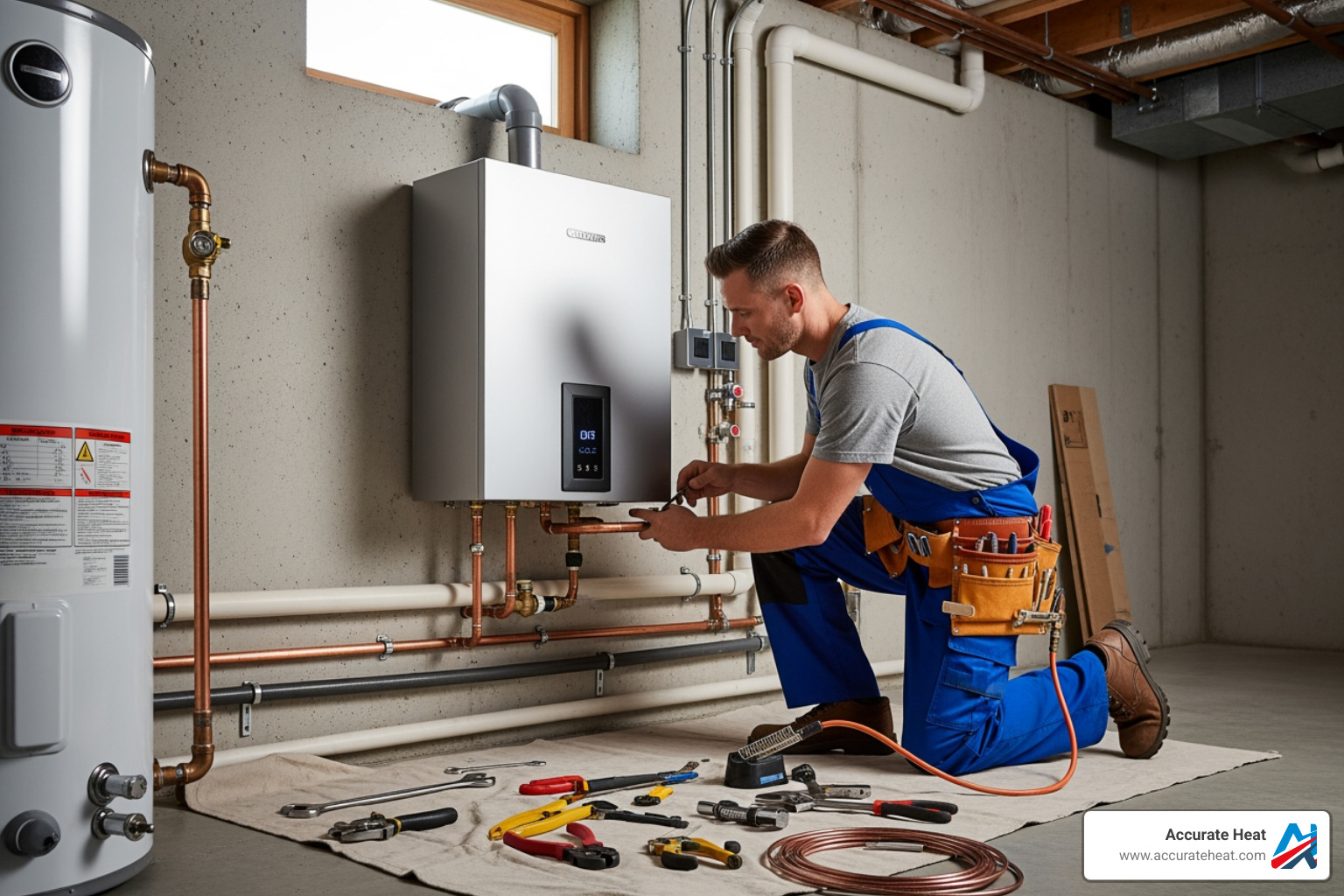
Installation complexity is another factor. Swapping a tankless unit for a traditional one isn’t always a simple plug-and-play operation. It might involve upgrading gas lines, increasing electrical capacity, or modifying venting systems. This means professional installation is crucial, and it’s not a DIY project for most homeowners.
Then there’s the issue of flow rate limitations. While tankless heaters provide endless hot water, they can only heat so much water at once. If your family enjoys multiple showers, a running dishwasher, and a load of laundry simultaneously, a single tankless unit might struggle to keep up, leading to lukewarm surprises. For larger households or those with high simultaneous demand, this can be a real headache.
Power outage vulnerability is also a consideration. Most tankless water heaters (especially electric ones, and even gas models with electronic ignitions) rely on electricity to operate. During a power outage in Medway or Bellingham, you might find yourself without hot water, which can be a chilly experience in a Massachusetts winter. Some homeowners opt for battery backup generators to mitigate this, but that’s another added cost.
Finally, let’s talk maintenance. While they last longer, tankless units aren’t maintenance-free. They require regular flushing and descaling, especially in areas with hard water, to prevent mineral buildup that can reduce efficiency and lifespan.
Why the high cost might make you ask ‘are tankless water heaters better for my budget?’
When considering if are tankless water heaters better for your specific budget, the upfront cost is usually the first hurdle.
- Purchase Price vs. Tank Models: The initial purchase price for tankless units can vary significantly, from around $500 for electric units to up to $4,000 for high-end or solar-powered models. Whole-home tankless units typically range between $500 and $2,000. Compare this to a conventional tank water heater, which usually costs between $800 and $1,500 for the unit itself.
- Professional Installation Costs: This is where the price can jump. Professional tankless water heater installation costs hover around $2,800 on average. Labor costs alone can range from $600 to $2,500. For electric models, labor might be $150 to $1,000, but for natural gas models, it’s often higher, between $900 and $1,500.
- Potential for Electrical or Gas Line Upgrades: A significant portion of the installation cost can come from necessary infrastructure upgrades. If you’re switching from electric to gas, or if your existing gas line isn’t sufficient for the higher demand of a tankless unit, you might need new gas lines or upgrades costing between $350 to $750, or even up to $2,000 for new installations. Similarly, large electric tankless heaters might necessitate hiring an electrician for rewiring and upgrading your electrical panel.
- Payback Period: While tankless units offer significant energy savings, the higher upfront costs mean a longer payback period. Studies show this can range from 10 to 25 years, depending on the system, your household’s hot water usage, and local energy prices. Electric tankless models generally offer faster payback periods than gas models, but this can vary. We’re talking about a long-term investment that pays off over many years, so it’s crucial to consider how long you plan to stay in your Massachusetts home.
Details on Water Heater Installation Services in MA
So, are tankless water heaters better for your home?
Now for the million-dollar question: are tankless water heaters better for your specific needs in Franklin, Norfolk, or any other Massachusetts community? The answer, as we’ve seen, isn’t universal. It truly depends on a careful evaluation of your lifestyle, budget, and home.
Let’s summarize the main differences between tankless and traditional water heaters to help you visualize the comparison:
| Feature | Conventional Tank Water Heater | Tankless Water Heater |
|---|---|---|
| Upfront Cost | Lower ($800 – $1,500 for unit) | Higher ($500 – $4,000 for unit, plus higher installation) |
| Operating Cost | Higher (due to standby heat loss) | Lower (heats on demand, up to 34% more efficient) |
| Lifespan | 10 – 15 years | 20+ years (with proper maintenance) |
| Hot Water Supply | Limited (can run out) | Endless (heats on demand) |
| Space Required | Significant (large tank, 40-60+ gallons) | Minimal (compact, wall-mounted) |
| Maintenance | Relatively low (annual check-ups) | Regular flushing/descaling (especially in hard water areas) |
| Installation | Simpler, often direct replacement | More complex, may require electrical/gas line upgrades |
| Cold Climate Impact | Less affected (tank maintains temp) | Can be impacted by very cold incoming water, reducing flow |
| Power Outage | Some gas models may still work (pilot light) | Typically no hot water (requires electricity for ignition) |
When making your decision, consider your:
- Household size and hot water demand: A large family that frequently uses multiple hot water appliances simultaneously might be better served by a traditional 80-gallon water tank if a single tankless unit can’t meet the demand. However, if your peak usage isn’t extreme, or you’re a smaller household, tankless can be perfect.
- Budget considerations: Can you afford the higher upfront cost for the long-term savings? Or is immediate affordability your priority?
- Home layout and available space: Do you have a cramped utility closet or a finished basement where a bulky tank is an eyesore or takes up valuable real estate?
- Climate impact: Here in Massachusetts, our incoming groundwater can be quite cold, especially in winter. This means a tankless unit might need more time to heat the water to your desired temperature, potentially impacting its flow rate. It’s a factor we at Accurate Heat always consider when sizing a unit for our local customers.
When are tankless water heaters better for specific households?
While not for everyone, tankless water heaters shine in particular situations:
- Small to mid-sized families with predictable usage: If your household doesn’t constantly demand hot water from multiple sources at once, a tankless unit can provide all the hot water you need efficiently.
- Homes with space constraints: If your water heater is currently stashed in a closet and you don’t have a basement, the compact, wall-mounted design of a tankless unit can be a huge advantage.
- Eco-conscious homeowners: For those prioritizing energy efficiency and a smaller carbon footprint, tankless systems are a clear winner.
- New construction or major renovations: If you’re already undertaking significant plumbing or electrical work, incorporating a tankless system is much easier and often more cost-effective than trying to retrofit one into an older, less compatible setup.
- Long-term homeowners: If you plan to stay in your home for 10-15 years or more, the long-term energy savings will eventually offset the higher upfront cost, making it a sound financial investment over time.
Compare options in our Tankless vs Traditional Water Heaters guide
Frequently Asked Questions about Tankless Water Heaters
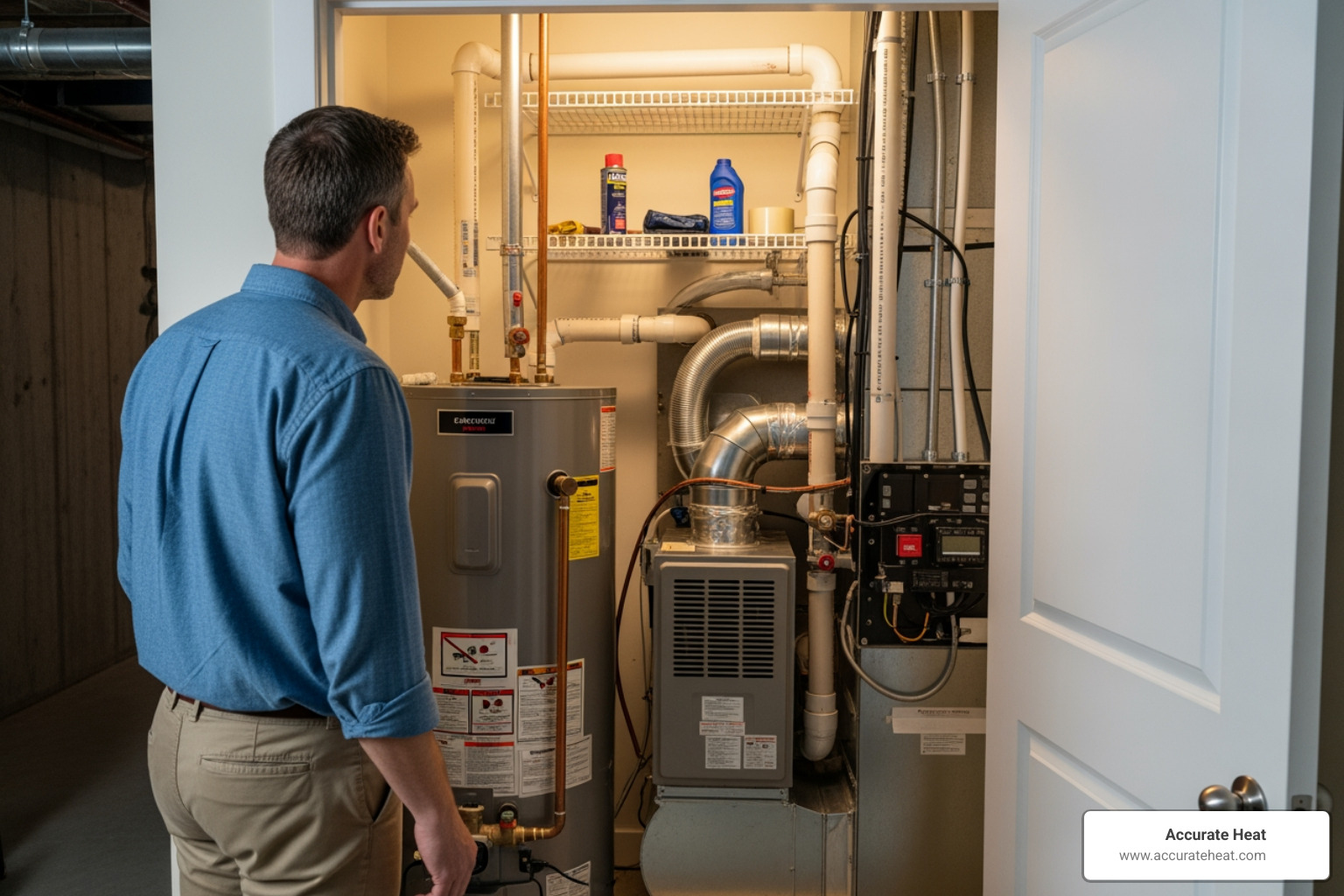
We hear a lot of questions about tankless water heaters from our customers across Massachusetts. Let’s tackle some of the most common ones.
What maintenance does a tankless water heater require?
While tankless water heaters boast a longer lifespan, they aren’t entirely hands-off. The most critical maintenance task is annual flushing and descaling. This process removes mineral deposits (like calcium and magnesium) that can build up inside the heat exchanger, especially in areas with hard water like parts of Massachusetts. If not flushed, these deposits can reduce efficiency, restrict water flow, and ultimately shorten the unit’s lifespan.
The process typically involves:
- Shutting off the water and power to the unit.
- Connecting a small pump, a bucket, and two hoses to the unit’s isolation valves.
- Circulating a descaling solution (often a few gallons of white distilled vinegar) through the system for about an hour.
- Flushing the system with fresh water.
While some homeowners with a DIY spirit might attempt this, we generally recommend professional maintenance. Our licensed plumbers at Accurate Heat have the right tools and expertise to ensure your unit is properly cleaned, calibrated, and inspected, helping you maintain efficiency and prevent costly repairs down the line.
Why Regular Plumbing Maintenance is a Must in Massachusetts
Why aren’t all electric tankless models Energy Star certified?
This is a fantastic question that often puzzles homeowners, especially given the high efficiency claims of electric tankless units. The simple answer lies in the EPA’s measurement methodology.
Energy Star primarily measures water heater efficiency at the unit itself, rather than at the point of use. While electric tankless water heaters can achieve an impressive thermal efficiency rating of 99 percent (meaning 99% of the electricity used goes directly into heating the water), they often require a significant amount of electricity instantly. The Energy Star rating system, in its current form, struggles to accurately compare the overall energy consumption and benefits of these “on-demand” electric units to other solutions, particularly considering the source of electricity and grid demands.
Despite this, their efficiency at the point of use is undeniable. They heat water almost instantly, reducing heat loss in transit and preventing water waste by eliminating the wait for hot water. Moreover, tankless electric water heaters are approved under other green building programs, such as the U.S. Green Building Council’s LEED certification program, which recognizes their environmental benefits. So, while they might not always carry the familiar Energy Star label, their energy-saving potential is real.
How do I choose the right size tankless water heater?
Sizing a tankless water heater isn’t about tank capacity; it’s about flow rate (GPM) and temperature rise. This is crucial, especially in Massachusetts where our cold groundwater means a higher temperature rise is needed in winter.
Determine Peak Hot Water Demand (GPM):
- List all the hot water appliances you might use simultaneously.
- Estimate the GPM for each:
- Shower: ~2.0-2.5 GPM
- Dishwasher: ~1.0-2.0 GPM
- Washing Machine: ~1.5-3.0 GPM (front-loading uses less, ~10 gallons per load; agitator top-loading ~20 gallons per load)
- Faucet: ~0.5-1.5 GPM
- Add up the GPM for your typical peak usage. For example, a shower (2.5 GPM) + dishwasher (1.5 GPM) = 4.0 GPM peak demand. Tankless heaters can deliver about two to five gallons of hot water per minute, so matching this carefully is key.
Calculate Temperature Rise:
- This is the difference between your incoming cold water temperature and your desired hot water temperature.
- In Massachusetts, incoming groundwater can drop to 35-40°F in winter. If you want 120°F hot water, you need a temperature rise of 80-85°F.
- A tankless unit’s GPM capacity decreases as the required temperature rise increases. A unit that provides 8 GPM with a 40°F rise might only deliver 4 GPM with an 80°F rise. This is a critical factor for us to consider for your home in Franklin or Wrentham.
Consult a Professional:
- Given the complexities of GPM, temperature rise, and local climate factors, we highly recommend consulting with a licensed plumbing professional from Accurate Heat. We can accurately assess your household’s specific needs, consider your home’s existing infrastructure, and recommend the right size and type of tankless water heater to ensure you get consistent hot water, even on the coldest Massachusetts mornings.
For more detailed guidance, you can also refer to the Official guidance on Sizing a New Water Heater from the U.S. Department of Energy.
Making the Final Decision for Your Massachusetts Home
So, we’ve weighed the pros and cons, explored the costs, and answered some burning questions. The debate of are tankless water heaters better boils down to what “better” means for your household.
Tankless water heaters offer compelling advantages: significant energy savings, an endless supply of hot water, a longer lifespan, and a compact design that frees up valuable space. These benefits are particularly attractive to homeowners in Massachusetts looking to reduce their energy bills and environmental footprint over the long term.
However, we can’t ignore the drawbacks: the higher upfront cost, the potential for complex installation and infrastructure upgrades, and the need for regular maintenance. For larger families with high simultaneous hot water demands or those with tighter initial budgets, a traditional tank water heater might still be the more practical and immediate solution.
The “best” choice isn’t about one system being inherently superior to the other; it’s about finding the perfect fit for your unique circumstances.
Here are our final decision points to consider:
- Budget: Can you comfortably afford the higher upfront investment of a tankless system for the promise of long-term savings?
- Space: Is freeing up space a high priority in your home?
- Demand: Do you frequently run out of hot water, or do you have multiple appliances and showers running simultaneously?
- Longevity & Maintenance: Are you prepared for the slightly more involved annual maintenance of a tankless unit in exchange for a longer lifespan?
- Long-Term Goals: How long do you plan to stay in your home? The longer you stay, the more likely a tankless unit will pay for itself in energy savings.
- Local Climate: Our cold Massachusetts groundwater can affect tankless performance, making proper sizing by a local expert even more critical.
At Accurate Heat, we’ve been providing reliable HVAC and plumbing services across Franklin, Norfolk, Medway, and beyond for over 30 years. We understand the specific challenges and needs of Massachusetts homeowners. Our team is dedicated to offering expert, honest, and timely solutions to improve your home comfort. We’ll never push you towards a solution that isn’t right for your family and your budget.
Ready to Upgrade Your Hot Water Experience?
Whether you’re leaning towards tankless or still weighing your options, our team is here to help. We can provide a personalized consultation, assess your current system, discuss your hot water needs, and give you a clear, upfront estimate for the best solution for your Massachusetts home.