
Why Massachusetts Homeowners Are Upgrading Their Comfort Systems
Adding central air to forced air heat is not only possible—it’s one of the smartest upgrades you can make to your Massachusetts home. If you’re sweltering through another summer, here’s what you need to know:
Quick Answer: Yes, You Can Add AC to Forced Air Heat
- Your existing ductwork does most of the heavy lifting – If you have forced-air heating, you already have the distribution system needed for central AC.
- You’ll need two main components – An outdoor condenser unit and an indoor evaporator coil that connects to your furnace.
- Typical cost range – $3,000 to $7,000 for homes with existing ductwork in good condition.
- Installation timeline – Usually 2-5 days for a standard setup.
- Key requirement – Your ductwork must be properly sized and sealed, and your electrical system must handle the added load.
While most American households have air conditioning, many older Massachusetts homes were built before central cooling was standard. The good news is that your forced-air furnace already provides the ductwork, solving half the problem.
The system works by using the same ducts that deliver warm air in winter to circulate cool air in summer. Your furnace’s blower works year-round, and adding an outdoor condenser and indoor evaporator coil transforms your heating system into a complete climate control solution.
However, this conversion isn’t always straightforward. Not every forced-air system is ready for AC without modifications like duct sealing, electrical panel upgrades, or a more capable furnace blower.
This guide covers the technical requirements, costs, and alternatives to help you make an informed decision about adding central air to your existing forced-air heating system.
The Perks of an Integrated System: Why Add AC?
Living in Massachusetts, we’re no strangers to sweltering summer days. While a window unit offers temporary relief, the benefits of adding central air to your forced air heat lift your entire home comfort experience.
An integrated system provides whole-home cooling, delivering a consistent, comfortable temperature to every room. Unlike noisy window units that cool a single space, central air uses your existing ductwork to ensure even temperature distribution throughout your home.
This approach is also cost-effective. Since your home already has ductwork, a significant part of the infrastructure is in place. This “existing ductwork advantage” reduces installation complexity and overall costs because we’re adding components, not building a system from scratch.
An integrated central AC system also improves indoor air quality. The filters in your forced-air system work year-round, continuously removing dust, pollen, and other allergens. This filtration benefit provides cleaner, healthier air, which is especially valuable for those with allergies or respiratory issues.
Central air also offers superior humidity control. A properly sized central AC system actively dehumidifies the air, making your home feel cooler and more comfortable at higher temperatures, which can lead to energy savings.
Finally, adding central air to forced air heat is a smart investment that can significantly increase your home value. Research suggests that central air can add 5%–7% to your home’s value. It transforms your home into a more comfortable, modern living space, all while eliminating window units that block views, pose security risks, and are a hassle to install and remove each season.
The Process of Adding Central Air to Forced Air Heat
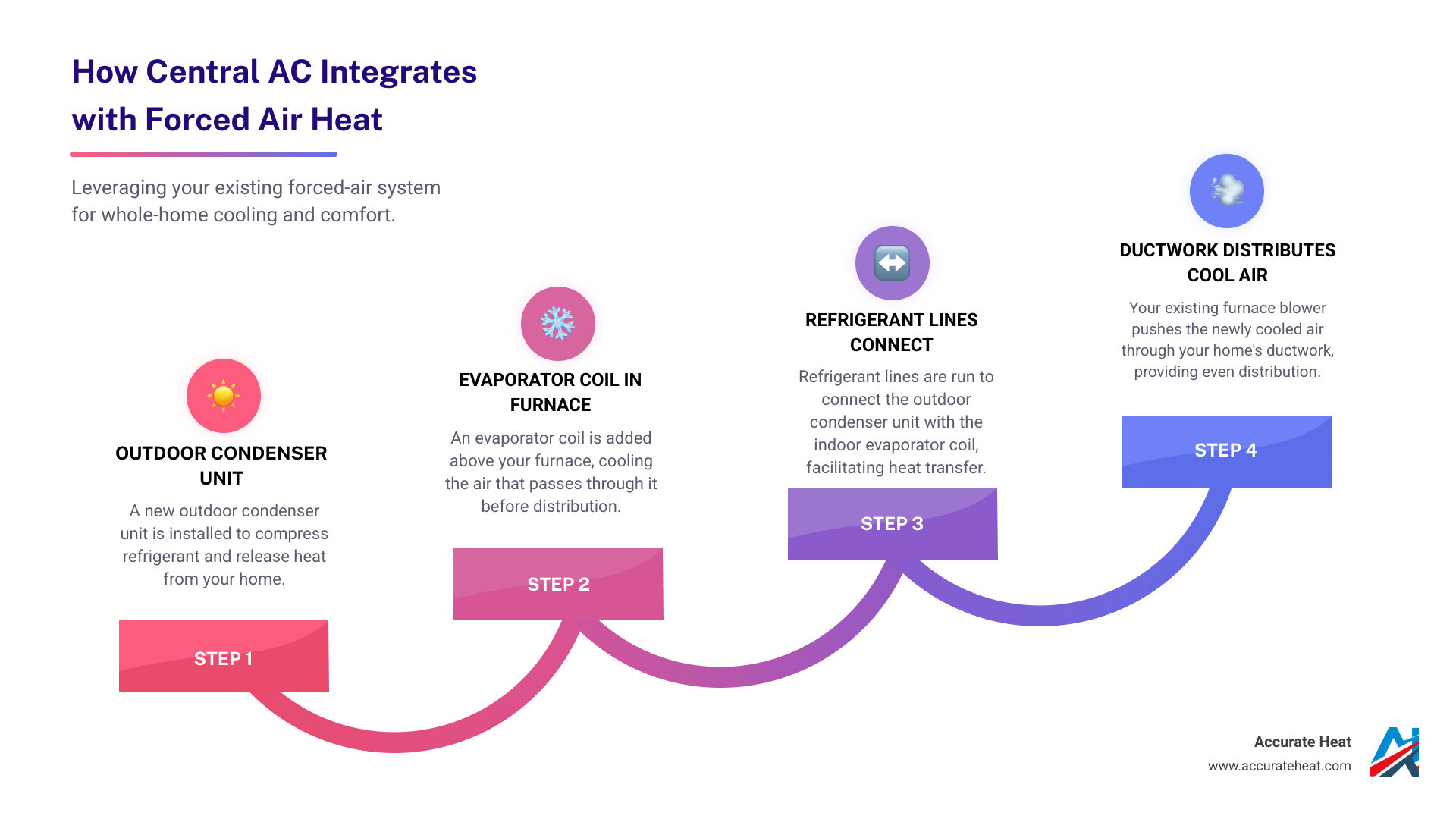
If you already have a forced-air heating system, you’re halfway to adding central air. The process of adding central air to forced air heat primarily involves integrating new cooling components with your existing setup.
A central air conditioning system is a “split system” with an indoor and an outdoor unit. Here’s how they come together:
- The Evaporator Coil: We install the evaporator coil into your furnace’s plenum. As your furnace’s blower pushes air over this cold coil, heat and humidity are absorbed, and cool, dry air is sent into your ductwork.
- The Condenser Unit: This outdoor unit houses the compressor and a fan. It releases the heat absorbed from your home into the outside air.
- Refrigerant Lines: These copper lines connect the indoor and outdoor units, carrying refrigerant to transfer heat.
- Electrical Connections: Both units require dedicated electrical power.
- Condensate Drain: This drain removes water that condenses on the evaporator coil as humidity is removed from the air.
These components work with your existing furnace and ductwork to provide efficient whole-home cooling.
Key Considerations Before Adding Central Air to Forced Air Heat
A thorough assessment of your existing system is crucial for optimal performance and efficiency.
- Ductwork Inspection and Sealing: Your existing ductwork needs a careful inspection. Leaky ducts can waste up to 30% of conditioned air, increasing energy bills. We prioritize duct sealing to fix leaks. Improperly sized ducts can also restrict airflow, straining your AC system.
- Insulation R-Value: Older Massachusetts homes are often under-insulated, allowing cool air to escape. Insulation over 20 years old may have an insufficient R-Value. Upgrading your home’s insulation reduces your AC’s workload, saving money and improving comfort.
- Furnace Blower Capacity: Your furnace’s blower motor must be powerful enough to circulate cool air effectively. We’ll assess if your current blower can handle the load. Sometimes, an upgrade is needed for optimal performance.
- Electrical Panel Capacity and Circuit Breaker Upgrades: Central AC requires significant power. We’ll assess your electrical panel to ensure it can handle the new load. An electrical panel upgrade ($750 to $2,000) might be necessary for safety, as the new unit needs a dedicated circuit.
Sizing the System: Proper sizing is critical. An undersized AC runs constantly without cooling effectively, while an oversized unit “short cycles,” wasting energy and failing to dehumidify. To avoid these oversizing pitfalls and undersizing issues, we perform a specialized calculation.
- What is a Manual J calculation, and why is it important for properly sizing an AC system?
A Manual J calculation is the industry-standard method for determining a home’s precise cooling load. It goes beyond simple square footage, considering factors unique to your Massachusetts home, such as: - Window size and orientation
- Insulation levels
- Local climate data
- Ceiling heights
- Heat-generating appliances
- Air infiltration rates
This detailed analysis ensures we select an AC unit with the perfect British Thermal Unit (BTU) capacity for your home, guaranteeing optimal comfort and efficiency. You can learn more about this crucial step here.
- What is a Manual J calculation, and why is it important for properly sizing an AC system?
Older Home Challenges: Adding central air to forced air heat in older homes can present challenges like limited space or needing extensive electrical work. If significant modifications are needed, costs can range from $6,000 to $17,000 or more, but the investment pays off in comfort and resale value.
The Installation: What to Expect
Once we’ve selected the right system, our certified technicians will begin the installation.

- Evaporator Coil Placement: We install the new evaporator coil into your furnace’s supply plenum, modifying the sheet metal for an airtight fit.
- Condenser Pad Installation: The outdoor condenser needs a stable, level surface. We prepare a concrete or composite pad for proper condenser pad installation, ensuring quiet, efficient operation while adhering to local codes.
- Running Refrigerant Lines: Our EPA-certified technicians run insulated copper refrigerant lines between the indoor and outdoor units, ensuring a proper seal to prevent damage.
- Condensate Drain Setup: We install a condensate drain setup to safely route water removed during dehumidification away from your home.
- Electrical Supply: We connect the AC system to your electrical panel with a dedicated circuit for safe, reliable operation.
- Thermostat Integration: We integrate the AC with your thermostat or install a new one, often a smart thermostat, for convenient control.
- Zoned Systems: If you have a zoned forced-air system, we can integrate the new AC to work with your existing zones for optimized comfort.
- Installation Timeline: A standard installation takes 2 to 5 days. The exact duration depends on factors like ductwork modifications, electrical upgrades, and home size.
Throughout the process, our team at Accurate Baker Elman will keep you informed, ensuring your new system is installed efficiently and to the highest standards.
Decoding the Costs: What Influences the Price Tag?
Understanding the cost of adding central air to forced air heat is a major factor for many Massachusetts homeowners. The final price tag depends on several key elements.
The cost to install central AC ranges from $3,500 to $7,000 for homes with good ductwork. For older homes needing extensive ductwork or electrical upgrades, costs can be $6,000 to $17,000 or more.
Here’s a breakdown of the factors at play:
- Unit Size (Tonnage): The cooling capacity of an AC unit is measured in tons (1 ton = 12,000 BTUs). A larger home requires a larger, more powerful unit, which costs more. This is determined by our Manual J calculation.
- SEER Rating Explained: The Seasonal Energy Efficiency Ratio (SEER) measures an air conditioner’s energy efficiency. A higher SEER rating means it uses less electricity to produce the same amount of cooling.
- The savings can be significant. Upgrading from an old 9 SEER unit to a 14 SEER unit can cut operating costs by 35%, per the DOE. While high-SEER units cost more upfront, long-term energy savings can offset the investment.
- EER Rating: You might also see the Energy Efficiency Ratio (EER), which measures efficiency at a specific outdoor temperature (95°F). An EER of at least 11.6 is considered very good.
Here’s a simplified look at how SEER ratings impact potential savings:
| SEER Rating (Example) | Upfront Cost (Relative) | Annual Operating Cost | Long-Term Savings |
|---|---|---|---|
| 13-14 SEER (Minimum) | Lower | Moderate | Moderate |
| 15-17 SEER (Mid-Range) | Medium | Lower | Significant |
| 18+ SEER (High-Efficiency) | Higher | Lowest | Substantial |
- Ductwork Repair Costs: If your existing ductwork is old, damaged, or improperly sized, repairs or modifications will add to the cost. This can involve sealing leaks, adding insulation, or replacing sections.
- Electrical Upgrade Costs: If your home’s electrical panel needs upgrading, expect to spend an additional $750 to $2,000 for circuit breaker upgrades.
- Labor Costs: Labor often accounts for a significant portion of the total cost (around 60%), covering the expertise for sizing, installation, refrigerant handling, and electrical work.
- Permits and Inspections: Local regulations require permits for HVAC installations to ensure safety and code compliance. These fees are usually included in our quotes.
While the initial investment can seem substantial, you’re investing in improved air quality, home value, and long-term energy savings.
Exploring Your Options: Alternatives to Traditional Central AC
While adding central air to forced air heat is an excellent solution, it’s not the only option. Depending on your home’s structure, budget, and needs, other cooling systems might be a better fit.
- Ductless Mini-Split Systems: These are fantastic alternatives for homes without ductwork, new additions, or specific zones needing extra cooling. A mini-split has an outdoor compressor and one or more indoor air-handling units.
- Pros: Highly energy-efficient (zoned cooling), quiet operation, and easy installation. Many models also provide heat. They can last over 20 years.
- Cons: Higher upfront cost per indoor unit compared to traditional central AC, and the indoor units are visible.
- DIY Aspects: Some mini-splits are designed for DIY installation, but proper sizing, electrical work, and system commissioning still benefit from professional expertise.
- Heat Pumps: Often used in mini-split or central ducted systems, heat pumps provide both efficient heating and cooling. They are a great two-in-one solution that can lead to significant energy savings, especially in spring and fall.
- Geothermal Systems: These are the most efficient and sustainable option. Geothermal systems use the stable temperature of the earth for both heating and cooling.
- Pros: Extremely high efficiency (EERs 15+), low operating costs, long lifespan (50+ years for underground loops), and quiet operation. They often qualify for incentives.
- Cons: The upfront cost is significantly higher than traditional AC, and installation is more complex, involving underground piping that can take weeks or months.
We’re proud to be a Mitsubishi Electric Elite Diamond Contractor, offering top-tier mini-split and heat pump solutions throughout Franklin and Massachusetts.
DIY vs. Professional Help for Adding Central Air to Forced Air Heat
While DIY projects can save money, we strongly advise against a full DIY installation when adding central air to forced air heat. This is not a weekend warrior project.
- Refrigerant Handling: This is the biggest hurdle. Refrigerants require EPA-certified professionals for safe handling, as improper handling is illegal and harms the environment.
- Electrical Work: AC units require dedicated high-voltage circuits. This work is dangerous and should be done by a licensed electrician to prevent fire hazards or electrical shock.
- Specialized Tools and Expertise: Installation requires specialized tools and expertise for system sizing (Manual J), ductwork modification, and system commissioning.
- Partial DIY Tasks: You can save on labor by handling prep work like clearing the installation area or preparing the condenser pad. However, core tasks involving refrigerant or high-voltage electricity must be left to certified professionals.
- Professional Installation Benefits: Hiring qualified HVAC technicians ensures your system is installed correctly, safely, and efficiently, guaranteeing compliance with all local codes.
- Warranty Requirements: Most AC manufacturers require installation by licensed contractors for the warranty to be valid. A DIY installation could void your warranty.
At Accurate Baker Elman, we have over 30 years of experience providing reliable HVAC services in Franklin and throughout Massachusetts. Our expert, honest, and timely solutions ensure your new central air system is installed right the first time.
Frequently Asked questions about Converting Forced Air to AC
Here are some of the most common inquiries we receive from Massachusetts homeowners considering adding central air to forced air heat.
Can a single AC unit cool a home with a zoned forced-air system?
Yes. If your home has a zoned forced-air system with dampers, a single central AC unit can be integrated to work with it. This allows you to set different temperatures in different zones, optimizing comfort and energy use. Our technicians will ensure the controls are properly integrated with your existing zoning system.
How long does it take to install central AC in a home with a furnace?
For a home with a furnace and adequate ductwork, installation typically takes 2 to 5 days. The timeline depends on:
- System complexity and home size
- Need for ductwork modifications or electrical upgrades
- Local permitting and inspection schedules
Our team works efficiently to minimize disruption while ensuring a high-quality installation.
What are the main issues with using old ductwork for a new AC system?
Using old ductwork is a huge advantage, but it can have issues that must be addressed before installation to ensure your new AC system performs efficiently:
- Leaks: Leaks at joints and seams waste energy, make your AC work harder, and reduce cooling effectiveness.
- Improper Sizing: Ductwork designed only for heating may be too small for cooling, which requires a different airflow rate. This can restrict airflow and strain the new AC unit.
- Poor Insulation: Ducts in unconditioned spaces (like attics) must be insulated. Without it, cool air warms up as it travels, reducing efficiency and potentially causing condensation.
- Dirt and Debris: Old ductwork can circulate years of accumulated dust and allergens, harming indoor air quality. We often recommend duct cleaning as part of the installation.
Conclusion
Adding central air to forced air heat is a transformative home improvement that brings a new level of comfort, efficiency, and value to your Massachusetts residence. From the consistent whole-home cooling and improved indoor air quality to the long-term energy savings and increased property value, the benefits are clear.
We’ve explored the essential components, the critical pre-installation considerations like ductwork and electrical capacity, and the importance of precise system sizing through a Manual J calculation. We’ve also steerd the cost factors, from unit SEER ratings to potential electrical upgrades. While alternatives like mini-splits and geothermal systems offer their own unique advantages, integrating with your existing forced-air system often presents the most straightforward and cost-effective path to central cooling.
This is a complex project that requires professional expertise. Attempting a full DIY installation can lead to safety hazards, inefficient operation, and voided warranties. That’s why partnering with experienced professionals is paramount.
At Accurate Baker Elman, we pride ourselves on providing reliable HVAC and plumbing services in Franklin and throughout Massachusetts. With over 30 years of experience, our team offers expert, honest, and timely solutions for your home comfort needs. We’re here to ensure your transition to central air is smooth, efficient, and perfectly custom to your home.
Don’t let another summer catch you off guard. Take the first step towards a cooler, more comfortable home.
Get a professional quote for your heating and cooling installation.