
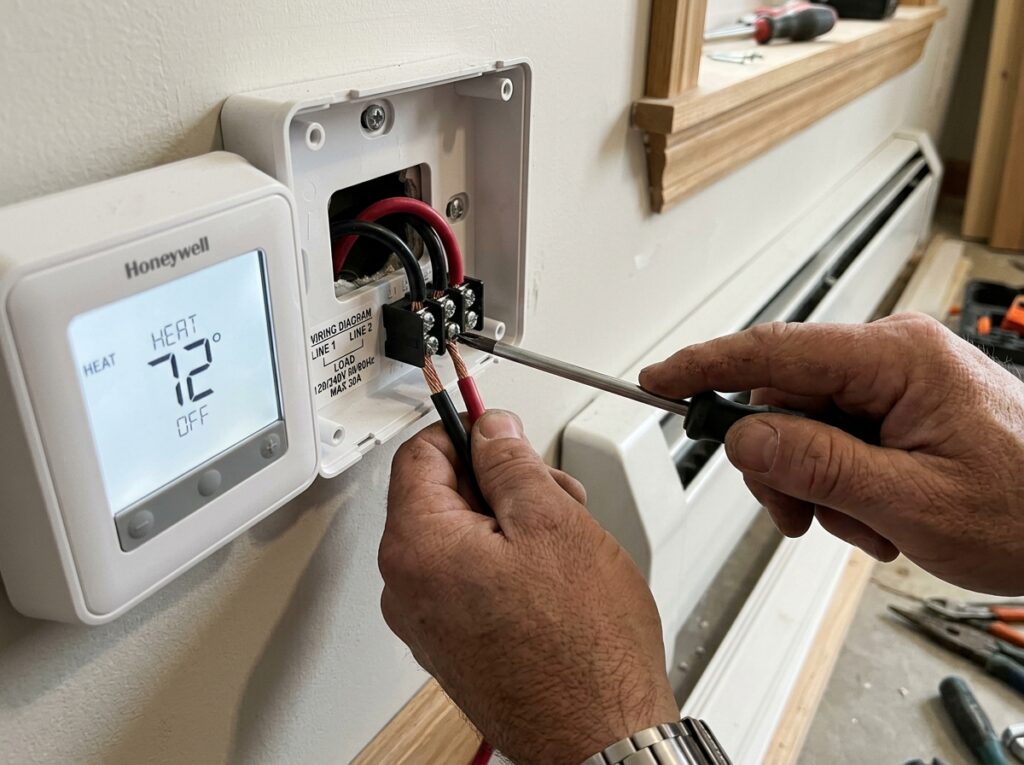
What You Need to Know About High Voltage Thermostat Wiring Before You Touch Anything
High voltage thermostat wiring controls electric heating systems — like baseboard heaters — that run directly on 120V or 240V power. That’s the same voltage as your wall outlets and major appliances. One wrong move can cause a serious shock, a tripped breaker, or worse.
Here’s a quick-reference summary of the essentials:
| Topic | Key Facts |
|---|---|
| Voltage | 120V or 240V (line voltage), not the 24V used by most central HVAC systems |
| Wire thickness | Thick 12-gauge wire (like wall outlet wiring), not thin thermostat wire |
| Wire colors | Black + white (120V) or black + red (240V) |
| Common heating systems | Electric baseboard heaters, fan-forced heaters, radiant floor heat |
| Thermostat types | Single-pole (SPST) or double-pole (DPST) — double-pole required for 240V |
| Key safety rule | Always turn off the circuit breaker and verify power is off before touching any wires |
| Load capacity | Typical mechanical thermostats handle 22 amps at 120/240V (up to 5,280W) |
About 30% of Canadian households and 10% of American homes heat with line voltage systems, according to energy research. In Massachusetts, electric baseboard heat is common — especially in older homes and multi-family buildings.
The tricky part? Even when your thermostat is switched off, the wires in the junction box can still carry live voltage. That surprises a lot of homeowners when they go to replace a thermostat and find every wire is hot. There’s a simple explanation for that — and we’ll walk through it all below.
This guide covers everything: how to identify your system, how to wire it safely, and how to test it when you’re done.
Understanding High Voltage Thermostat Wiring and Identification
Before we start stripping wires, we need to make sure we are actually dealing with high voltage. In HVAC, “high voltage” is often called “line voltage.” This is fundamentally different from the low-voltage systems found in most modern suburban homes in areas like Franklin or Medfield.
While a low-voltage thermostat acts like a remote control sending a tiny 24V signal to a furnace, a high-voltage thermostat acts like a heavy-duty light switch. It sits directly in the path of the electricity, physically opening and closing the circuit to let 120 or 240 volts flow into your heater.
Identifying High Voltage Thermostat Wiring in Your Home
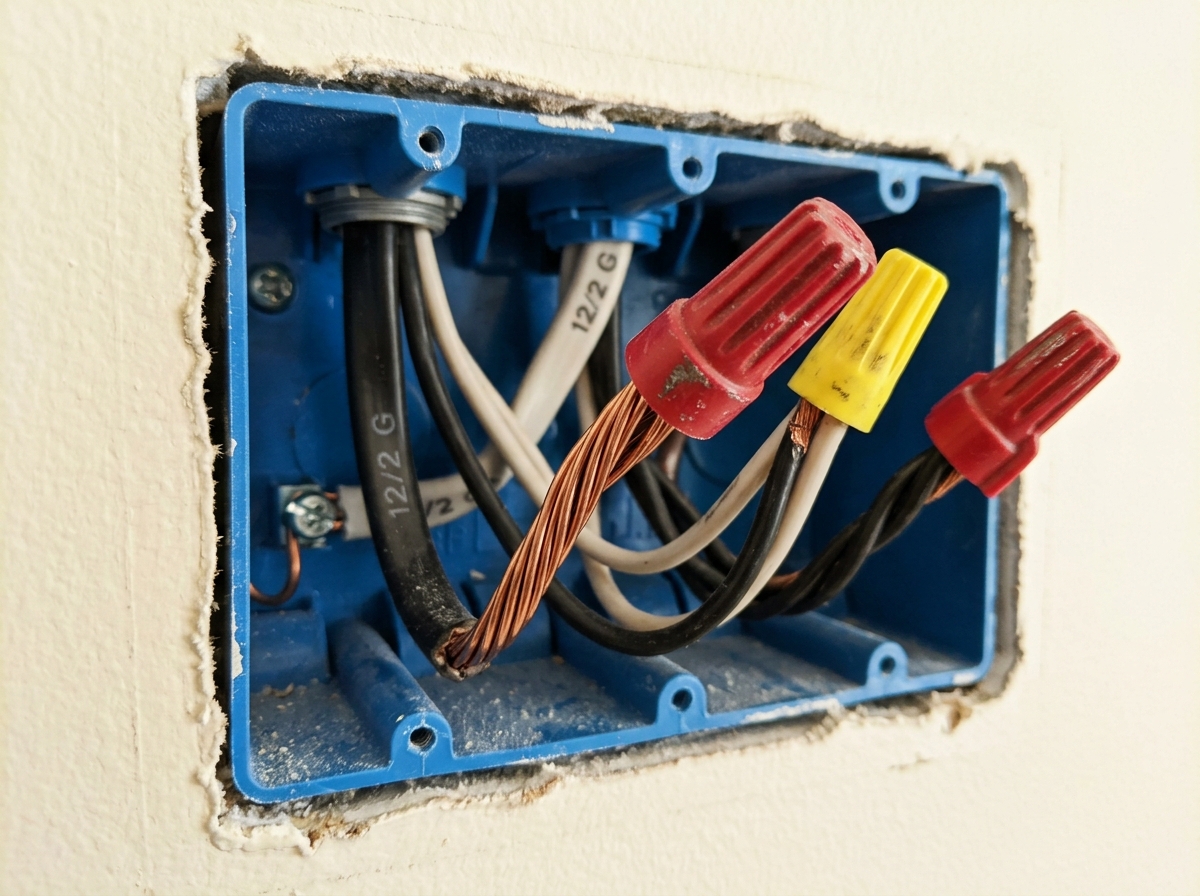
If you pop off your thermostat cover and see a tangle of tiny, multicolored wires (like the ones inside a telephone cord), you have a low-voltage system. However, if you see thick, stiff wires connected with wire nuts, you’ve found high voltage thermostat wiring.
Here are the tell-tale signs:
- Wire Thickness: These wires are typically 12-gauge or 14-gauge copper. They look exactly like the wires behind your kitchen outlets.
- Wire Colors: You will usually see black and red wires (for 240V systems) or black and white wires (for 120V systems).
- Voltage Labels: Look at the back of the thermostat. High-voltage units will be clearly labeled with “120 VAC,” “240 VAC,” or “277 VAC.”
- The Gang Box: High-voltage thermostats are almost always mounted inside a metal or plastic “gang box” recessed into the wall, just like a light switch.
If you are still unsure, you can check your thermostat wiring compatibility to see if your existing setup matches the requirements for a new unit.
Single-Pole vs. Double-Pole Wiring Configurations
When shopping for a replacement, you’ll see two main types: Single-Pole (SPST) and Double-Pole (DPST). This is a crucial distinction for both safety and local building codes.
- Single-Pole (2-wire): These thermostats only switch one “hot” wire. Even when the thermostat is turned all the way down, electricity is still present at the heater. These usually have two wires coming out of the back.
- Double-Pole (4-wire): These switch both “hot” wires in a 240V circuit. When you turn a double-pole thermostat to the “OFF” position, it completely disconnects the power from the heater.
In many Massachusetts jurisdictions, including Norfolk and Wrentham, the National Electrical Code (NEC Article 424) requires a “positive OFF” position for fixed electric space heaters. This usually means a double-pole thermostat is mandatory if it serves as the primary disconnect. Choosing the Right Thermostat for Your Heating System depends heavily on whether your system is 120V or 240V.
Line vs. Load: Determining Supply and Heater Wires
In a typical junction box, you’ll have two sets of wires: the “Line” (the supply coming from your circuit breaker) and the “Load” (the wires going to the heater).
If you have a 240V system, you might find that every wire in the box shows voltage on a non-contact tester, even if the thermostat is removed. This happens because 240V systems use two “hot” legs of 120V each. Also, in many homes, thermostats are “daisy-chained,” meaning the power comes into one box and then continues on to the next room.
To identify them:
- The Line: This is the wire that stays “hot” even when the thermostat is disconnected.
- The Load: This wire only becomes hot when the thermostat “calls” for heat.
If you’re staring at a box of wires and nothing seems to make sense, it’s a sign that the original wiring might be non-standard. What to Do If Your Thermostat Isn’t Working often starts with verifying these basic connections with a multimeter.
Step-by-Step Installation and Safety Precautions
Working with high voltage thermostat wiring is not like changing the batteries in your TV remote. We are dealing with enough current to cause an arc flash or a serious fire if handled incorrectly.
Essential Safety for High Voltage Thermostat Wiring
The first and most important step is de-energizing the circuit. Don’t just turn the thermostat down; go to your main service panel and flip the breaker.
Safety Checklist:
- Verify Power is Off: Use a non-contact voltage tester or a multimeter. Never assume a breaker is labeled correctly.
- Check Load Capacity: Mechanical line voltage thermostats are often rated for 22 Amps. If you have a massive baseboard heater that exceeds 5,280 Watts at 240V, you could melt the thermostat and start a fire.
- Grounding: Always connect the green or bare copper ground wires to the metal junction box or the ground screw on the new thermostat.
- Aluminum Wiring: If your home in Bellingham or Millis was built in the late 60s or early 70s, you might have aluminum wiring. Do not use standard wire nuts. You must use special CO/ALR solderless connectors to prevent the wires from overheating.
For a deeper dive into the technical side of testing, you can review the Electric Thermostat Test Procedure used by professionals.
Installing Smart Thermostats on Line Voltage Systems
Can you have a smart home if you have baseboard heaters? Yes! While the famous brands like Nest or Ecobee are designed for 24V systems, there are specialized smart thermostats made specifically for high voltage thermostat wiring.
These units (like those from Mysa or Sinope) allow you to control your baseboard heat from your phone. However, they have specific requirements:
- The “C-Wire” Problem: Most smart thermostats need constant power to run their WiFi chips and screens. In a high-voltage system, this usually means the thermostat needs to be connected to both legs of the 240V line to complete its own internal circuit.
- Relay Capacity: Ensure the smart thermostat can handle the amperage of your heaters. Some are limited to 15 or 16 amps, which is lower than the 22-amp rating of old mechanical dials.
Smart Thermostats: The Future of Heating Control can save you a significant amount on your monthly energy bills — which average around $112 for many Americans — by preventing “overshoot” common with old bimetal thermostats.
Troubleshooting and Testing Your New Installation
Once you’ve followed our Mastering Thermostat Installation: A Step-by-Step Guide, it’s time to test.
- The Click Test: Turn the dial (or digital setting) up high. You should hear a distinct “click.” This is the internal relay or switch closing.
- The Heat Check: Feel the heater. It should begin to get warm within two minutes.
- Calibration Check: If your room feels like a sauna but the thermostat says it’s 65 degrees, the unit might be affected by “droop” or drafts inside the wall. Make sure the hole where the wires come through the wall is plugged with a bit of insulation.
If the heater never turns off, or if you hear a “chattering” sound (rapid clicking), turn off the power immediately. This usually indicates a wiring error or a faulty relay. In these cases, it’s best to call in the experts. At Accurate Baker Elman, we’ve spent over 30 years helping neighbors from Holliston to Hopkinton with their HVAC Installation Services.
Common Questions About High Voltage Wiring
Why do all my wires show voltage even when the thermostat is off?
In a 240V system, you have two “hot” wires. Even if the thermostat breaks the connection on one wire, the electricity can “travel” through the heater element and show up on the other wires in the box. This is why you must always turn off the breaker before working.
Can I use a low-voltage thermostat for my baseboard heaters?
No. If you connect a 24V thermostat to 240V wiring, it will literally explode or melt instantly. You must use a thermostat specifically rated for line voltage.
What if I have more than four wires in the box?
This usually means your thermostat is a “pass-through” point. The extra wires are likely continuing the circuit to another thermostat in a different room (daisy-chaining). You’ll need to wire-nut the matching colors together so the downstream rooms still have power.
Is professional installation worth it?
Given that we are dealing with enough power to be lethal, professional installation provides peace of mind. Accurate Baker Elman is a Mitsubishi Electric Elite Diamond Contractor, and we serve the entire Metro West area, from Natick to Quincy. We ensure your high voltage thermostat wiring is up to code and operating at peak efficiency.
Whether you’re upgrading to a sleek digital interface or just replacing an old, yellowed dial, understanding the power behind the wall is the first step to a warm, safe home. If you’re in the Franklin area and feel like you’re in over your head, don’t risk a blown fuse — or worse. Give us a call, and we’ll get your heating system dialed in perfectly.