
What to Do When Your AC Unit Is Not Working
AC unit not working? Here are the most common causes and what to check first:
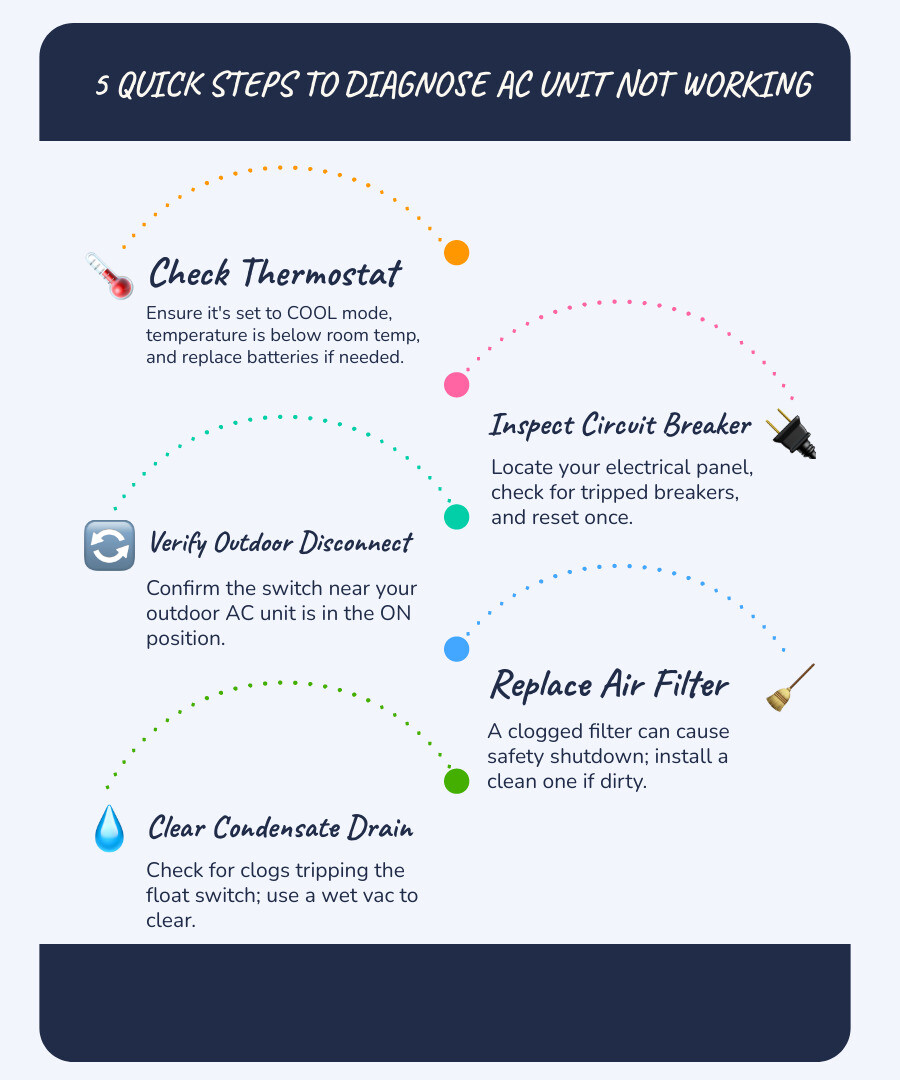
- Thermostat – Set to COOL mode, temperature below room temp, fresh batteries
- Circuit breaker – Check for a tripped breaker and reset it once
- Outdoor disconnect switch – May have been accidentally switched off
- Air filter – A clogged filter can trigger an automatic safety shutdown
- Condensate drain – A clogged drain trips the float switch and shuts the system down
- Capacitor or contactor – A humming outdoor unit with no startup often means capacitor failure
- Refrigerant – Low levels require a certified HVAC technician
Good news: simple checks like these resolve around 40% of AC no-start situations without a service call.
Few things are more miserable than coming home to a hot house on a sweltering Massachusetts summer day and realizing your AC has quit. The panic sets in fast.
But before you assume the worst, take a breath. Most AC failures come down to a small handful of causes — and many of them are things you can check yourself in under ten minutes.
This guide walks you through exactly what to look at, in the right order, so you can get your system running again as fast as possible — or know confidently when it’s time to call in a pro.
Troubleshooting Your AC Unit Not Working
When you realize your home is getting warmer by the minute, the first step is to stay calm and follow a systematic approach. An AC unit not working doesn’t always mean the entire system has reached the end of its life. In fact, many issues are related to the power supply or simple settings that have been bumped or changed.
The first place we always recommend looking is your electrical panel. Air conditioners draw a significant amount of power, especially during a Massachusetts heatwave when they are running almost constantly. This high demand can occasionally cause a circuit breaker to trip.

If you find a tripped breaker, flip it completely to the “OFF” position before flipping it back to “ON.” However, a word of caution: if the breaker trips again immediately or shortly after you reset it, do not keep trying. This is a safety mechanism telling you there is a short circuit or a serious electrical fault that requires professional ac-repair-services-in-ma.
Beyond the breaker, you should also consider the common-reasons-why-your-ac-wont-turn-on such as a simple power switch near your indoor air handler that might have been flicked off by mistake, or even a blown fuse in the outdoor disconnect box.
Quick Fixes for an AC Unit Not Working
Before you pick up the phone to schedule a service visit, run through this “Quick Fix” checklist. These steps address the most frequent “oops” moments we see in the field.
- The Thermostat Test: It sounds simple, but check your thermostat settings first. Ensure it is set to “COOL” and not “HEAT” or “FAN ONLY.” Set the temperature at least 5 degrees below the current room temperature to trigger a call for cooling. If the display is blank, replace the batteries immediately. Even if the display is visible, weak batteries can sometimes prevent the thermostat from sending a signal to the AC unit.
- Mind the Delay: Most modern AC systems have a built-in 5-minute delay timer. This protects the compressor from “short-cycling” after a power flicker or a sudden change in settings. If you just adjusted the thermostat, give it five minutes before assuming the AC unit not working is a permanent state.
- Check the Outdoor Disconnect: Next to your outdoor condenser unit, there is a small metal box mounted on the wall. This is the disconnect switch. Sometimes, kids playing in the yard or a stray ball can accidentally knock the handle to the “OFF” position. Ensure it is securely engaged.
- The Air Filter Factor: A dirty air filter is the silent killer of HVAC efficiency. If your filter is clogged with dust, pet hair, or Massachusetts pollen, airflow is restricted. This can cause the indoor evaporator coil to freeze or the system to overheat and shut down as a safety precaution. According to the Department of Energy, maintenance such as changing your filter every 60 days (or monthly if you have pets) is the single most important task for a homeowner.
Identifying Mechanical and Electrical Failures
If the power is on and the settings are correct but the outdoor unit still won’t start, you might be dealing with a component failure. One of the most common culprits is a failed capacitor.
Think of a capacitor as a large battery that provides the high-voltage “jolt” needed to start the compressor and the fan motor. These components typically have a 10-15 year lifespan. If you hear a faint humming or buzzing sound coming from your outdoor unit, but the fan isn’t spinning, the capacitor has likely failed.
If you are comfortable using a multimeter, you can test a capacitor for its rated microfarads (µF), but keep in mind that these components store a dangerous electrical charge even when the power is off. For most homeowners, this is a clear sign to look into common-summer-ac-problems and call for professional help.
Another mechanical failure point is the contactor. This is an electrical switch that closes to send power to the compressor. Over time, the contact points can “pit” or burn, or even become clogged with ants or debris, preventing the connection. If you hear a “click” from the outdoor unit when the thermostat calls for cooling, but nothing happens, the contactor or the compressor itself might be the issue.
Managing Drainage and Airflow Issues
Your air conditioner doesn’t just cool the air; it removes humidity. This moisture collects in a drain pan and flows out through a condensate line. If this line becomes clogged with algae or sludge — a common occurrence in our humid climate — the water backs up.
Most modern systems feature a “float switch” or safety sensor. When the water level in the pan gets too high, the switch trips and kills power to the entire system to prevent water damage to your home.
| Symptom | Likely Cause | First Step |
|---|---|---|
| Water pooling around indoor unit | Clogged Condensate Drain | Use a wet/dry vac on the exterior drain line |
| System won’t turn on; water in pan | Tripped Float Switch | Clear the clog and empty the pan |
| Vents blowing warm air; ice on pipes | Frozen Evaporator Coil | Turn off AC; check filter; let it thaw |
| Low airflow from all vents | Dirty Air Filter | Replace filter immediately |
If you suspect a clog, you can often use a shop vac on the end of the drain line outside to suck out the obstruction. Once cleared, flushing the line with a small amount of vinegar or a specialized drain cleaner can help prevent future buildup. If the system is still struggling, check out our guide on why-your-ac-isnt-cooling for deeper insights into airflow restrictions.
Troubleshooting a Window AC Unit Not Working
Window units face their own unique set of challenges. If your window AC unit not working is the problem, start with the power cord. Most window units use an LCDI (Leakage Current Detection and Interruption) plug. If the little green light on the plug is off, press the “RESET” button. If it trips again immediately, there may be a fray in the cord or an internal short.
For window units that run but don’t cool well, check the seals. Gaps around the side panels allow hot Massachusetts air to leak back inside, forcing the unit to work overtime. Using high-quality weather stripping and ensuring the unit is tilted slightly toward the outside (to allow proper drainage) can solve many performance issues. Also, listen for excessive vibration; this usually means the unit isn’t seated securely in the window frame or the fan blade is hitting a piece of debris.
Professional Solutions and Preventative Care
While DIY troubleshooting can save the day, some problems require the tools and expertise of a licensed technician. A major indicator that you need professional help is the “20-degree split.” A healthy AC system should be able to produce air that is roughly 20 degrees cooler than the air entering the return vent. If it’s 80°F in your house and the air coming out of the vents is 75°F, your system is failing to achieve the necessary heat exchange.
This often points to low refrigerant levels. Because AC systems are “closed loops,” they should never lose refrigerant. If the levels are low, it means there is a leak. Simply “topping it off” is a temporary fix; the leak must be found and repaired. This is especially critical for older systems using R-22 (Freon), which has been phased out and is increasingly difficult to source. If you’re facing a major repair on a system over 12-15 years old, we often recommend the “50% rule”: if the repair cost is more than 50% of the value of the system, it’s time to consider a replacement. You can explore our ac-repair-services-in-ma to see which path is right for you.
When to Call an HVAC Expert
Certain signs are immediate “red flags” that require you to shut down the system and call us:
- Hissing or Bubbling Noises: This almost always indicates a high-pressure refrigerant leak.
- Burning Smell: This suggests an electrical component is melting or a motor has seized.
- Frequent Breaker Tripping: As mentioned, this is a fire hazard and indicates a severe electrical fault.
- Ice on the Outdoor Unit: This can be caused by low refrigerant or a failing blower motor.
- Total Silence: If the thermostat is calling for cool and there is absolutely no sound from either the indoor or outdoor unit, there may be a failure in the main control board.
Handling refrigerant requires EPA Section 608 certification due to environmental regulations and personal safety risks. At Accurate Baker Elman, we have the specialized equipment to safely handle these gases and diagnose complex electrical shorts that a standard multimeter might miss. Check out our full range of ac-repair-services for expert assistance in Franklin and the surrounding towns.
Preventing Future Cooling Failures
The best way to handle an AC unit not working is to make sure it never happens in the first place. Annual professional tune-ups are the “oil changes” of the HVAC world. During a typical maintenance visit, we:
- Clean the condenser coils (dirty coils can reduce efficiency by 40%).
- Check refrigerant charge and look for tiny leaks.
- Tighten all electrical connections to prevent arcing and corrosion.
- Clear the condensate drain line to prevent float switch trips.
- Test the capacitor and contactor for signs of impending failure.
In Massachusetts, homeowners can often take advantage of Mass Save rebates and other incentives for upgrading to high-efficiency systems, such as Mitsubishi Electric heat pumps. As an Elite Diamond Contractor, we can help you navigate these programs to save money while improving your home’s comfort.
Regular maintenance doesn’t just prevent breakdowns; it extends the life of your equipment and keeps your energy bills in check. Don’t wait for the next heatwave to find out your system is struggling. Schedule your ac-repair-services today and stay cool all summer long!