What Massachusetts Homeowners Need to Know About Mass Save Boiler Replacement
Mass Save boiler replacement programs can help you cut heating costs, reduce emissions, and upgrade to a more efficient system — often with significant rebates or incentives.
Here’s a quick overview of what’s available:
| Situation | What’s Available |
|---|---|
| Boiler 30+ years old (gas, oil, or propane) | Early replacement rebate (up to $4,000) |
| High-efficiency condensing boiler (≥95% AFUE) | Tiered rebates for qualifying equipment |
| Income-eligible household | Enhanced incentives, including no-cost options |
| Replacing boiler with a heat pump | Rebates up to $15,000 per home |
| Fossil fuel boiler (standard household, post-2024) | Rebates have ended per Massachusetts’ 2021 Climate Act |
Massachusetts winters are unforgiving. When your boiler is old, inefficient, or on its last legs, the cost of doing nothing adds up fast — in wasted fuel, repair bills, and uncomfortable nights.
The good news? Mass Save, the state’s energy efficiency program backed by utilities like Eversource, National Grid, and others, has programs designed to help homeowners like you upgrade to better equipment — and offset a meaningful portion of the cost.
But the landscape has changed. Massachusetts’ 2021 Climate Act shifted the focus away from fossil fuel rebates and toward electric heat pumps. That means the path to savings looks different depending on your home, your fuel type, and your income level.
This guide walks you through exactly what’s available, what you qualify for, and how to get started.
Navigating Your Mass Save Boiler Replacement Options
If you’ve lived in Massachusetts for a while, you know that the “Mass Save” name is synonymous with energy savings. But what exactly is it? Mass Save represents a collaborative of natural gas and electric utilities—including Berkshire Gas, Cape Light Compact, Eversource, Liberty, National Grid, and Unitil—working together to provide residents with the resources to reduce energy consumption.
When it comes to a Mass Save boiler replacement, the goal is simple: move the state toward a cleaner, more efficient future. For years, this meant swapping an old “clunker” boiler for a shiny new high-efficiency gas model. However, following the 2021 Climate Act, the state’s policy has pivoted. Massachusetts is now aggressively pursuing “decarbonization,” which is a fancy way of saying we are trying to stop burning fossil fuels to heat our homes.

This policy change means that for most standard-income households, rebates for new natural gas, oil, or propane boilers have been phased out. The program now heavily incentivizes “electrification”—switching from a boiler to a high-efficiency heat pump.
| Equipment Type | Potential Rebate Amount | Efficiency Requirement |
|---|---|---|
| High-Efficiency Boiler | Limited (Income-Based Only) | ≥95% AFUE |
| Air Source Heat Pump | Up to $15,000 | ENERGY STAR® Certified |
| Ground Source Heat Pump | Up to $25,000 | ENERGY STAR® Certified |
While the shift toward electricity is the main headline, there are still vital pathways for those who need a traditional boiler, especially if you meet certain income requirements or have a very old system.
Eligibility for a Mass Save Boiler Replacement
The first question we often hear at Accurate Baker Elman is, “Do I qualify?” Eligibility for Mass Save boiler replacement incentives generally depends on three factors: your utility provider, your household income, and the age of your current equipment.
To participate, your home must be served by one of the Mass Save sponsors. This covers the vast majority of residents in towns like Franklin, Medway, and Newton. However, if you live in a town with a municipal electric company, you may need to contact them directly as they might not participate in the statewide Mass Save program.
One of the most important aspects of the current program is the focus on equity. Mass Save | Save with Enhanced Incentives are available for income-eligible households. If your household income falls within certain brackets, you may still be eligible for significant rebates—or even no-cost replacements—for fossil fuel equipment like natural gas or oil boilers. This ensures that everyone, regardless of budget, can stay warm during a Nor’easter without breaking the bank.
High-Efficiency Boiler Requirements and Rebate Amounts
For those who are eligible for a traditional boiler upgrade, the equipment must meet strict performance standards. Efficiency is measured by AFUE (Annual Fuel Utilization Efficiency). Think of AFUE like the MPG for your car; a 95% AFUE rating means 95 cents of every dollar you spend on fuel actually goes toward heating your home, while only 5 cents is lost up the chimney.
Most qualifying units are “condensing boilers.” These systems are high-tech; they capture “latent heat” from exhaust gases that old boilers just vent away. By cooling these gases until they condense into water, the system squeezes out every bit of warmth possible.
Historically, Mass Save offered “Early Replacement” rebates. If your boiler was 30 years or older (and still functional), you could receive up to $4,000 to replace it before it inevitably failed in the middle of January. While these specific fossil fuel “early” rebates have largely transitioned to support heat pumps for standard-income customers, they remain a cornerstone for income-qualified programs. You can find the latest technical specs on the Boilers & Furnaces page.
Transitioning from Boilers to High-Efficiency Heat Pumps
If you aren’t eligible for an income-based boiler rebate, don’t panic. The state is essentially “rolling out the red carpet” to help you switch to a heat pump. A heat pump doesn’t create heat by burning fuel; it moves heat from the outside air into your home. Even when it’s 5 degrees outside, there is still thermal energy available to be harvested.
The incentives here are massive. Whole-home heat pump rebates can reach up to $15,000. These systems provide both heating and cooling in one unit, meaning you can ditch the window AC units along with your old boiler. For homes with existing radiators or baseboard heat (hydronic systems), “air-to-water” heat pumps are an emerging technology that can sometimes utilize your existing pipes.
To learn more about how these systems work in our cold climate, visit MassSave.com/HeatPump. Many of our customers in areas like Wellesley and Needham are finding that with the $15,000 rebate, the net cost of a heat pump is often comparable to or even cheaper than a high-end boiler, while offering much lower long-term operating costs.
How to Secure Your Rebate and Maximize System Efficiency
Getting a rebate isn’t just about picking a piece of equipment; it’s about a holistic approach to home comfort. Mass Save operates on the philosophy that there is no point in putting a high-efficiency heater into a “leaky” house. If your windows are drafty and your attic is poorly insulated, your new boiler will just be working overtime to heat the neighborhood.
This is why Mass Save often requires a Home Energy Assessment before you can unlock the biggest rebates. During this assessment, specialists look for “weatherization” opportunities. By air sealing gaps and adding insulation (often subsidized at 75% to 100% of the cost), you can ensure your new system operates at peak efficiency.
Don’t forget the controls! Upgrading to a smart thermostat can save you an additional 5-10% on your heating bills. And if you are replacing an old thermostat, many older models contain mercury. You should properly dispose of them through the Thermostat Recycling Corporation to keep those toxins out of our Massachusetts soil and water.
Step-by-Step Guide to Your Mass Save Boiler Replacement
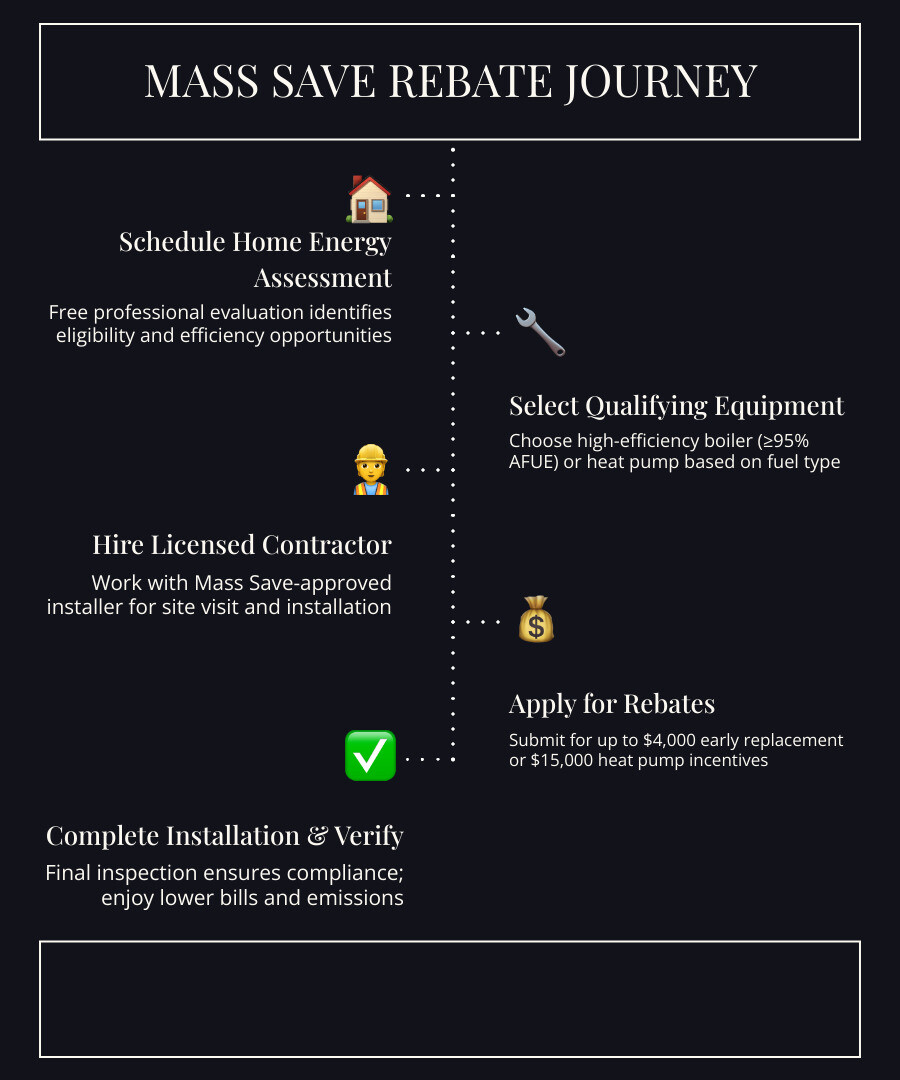
The process might seem daunting, but it follows a logical path. Here is how we typically help our neighbors in Franklin and surrounding towns navigate the journey:
- The Site Visit: Schedule a no-cost Home Energy Assessment. This is the “Golden Ticket” that opens the door to most Mass Save programs. A specialist will visit your home, provide energy-saving LED bulbs, and identify where you’re losing heat.
- The Quote: Contact a licensed contractor (like us!) to get a quote on a qualifying system. We will perform a “Manual J” load calculation. This is a technical way of sizing the unit perfectly for your home’s square footage and insulation levels.
- Financing: Before you sign on the dotted line, look into the HEAT Loan. This program offers 0% interest financing for up to $25,000 for qualifying energy efficiency upgrades. It’s a fantastic way to spread the cost of a Mass Save boiler replacement over several years without paying a dime in interest.
- Installation: Your contractor installs the unit. If you are doing a whole-home heat pump conversion, there are specific “disablement” requirements for your old boiler to ensure you get the full rebate.
- The Rebate: Submit your paperwork. Some contractors offer “instant rebates” where they take the rebate amount right off your invoice, saving you from waiting weeks for a check.
For more details on common hurdles, check out our guide on mass-save-10000-rebate-not-so-fast-there-are-qualifications/. It’s important to have all your ducks in a row before the installation begins.
Maintenance Tips for Long-Term Boiler Efficiency
Once your new system is in place, you want to keep it running like a Swiss watch. High-efficiency boilers, particularly condensing models, require a bit more “TLC” than the old cast-iron beasts of the 1970s.
- Annual Service: This is non-negotiable. A technician should check the combustion controls and ensure the “outdoor reset” sensor is working correctly. This sensor tells the boiler how cold it is outside so it can adjust its water temperature accordingly—sort of like cruise control for your heat.
- System Flush: If you have an indirect hot water tank paired with your boiler, it should be flushed annually to remove sediment.
- Filter Checks: If you’ve transitioned to a heat pump, you’ll need to clean or replace filters every few months to maintain airflow.
We’ve put together a comprehensive resource on maximizing-efficiency-tips-for-maintaining-boiler-systems/ to help you protect your investment.
Conclusion: Partnering with Experts for Your Mass Save Boiler Replacement
Navigating energy rebates, AFUE ratings, and decarbonization policy can feel like a full-time job. But you don’t have to do it alone. At Accurate Baker Elman, we’ve been serving the Franklin, MA community and surrounding areas like Norfolk, Medway, and Bellingham for over 30 years.
As a Mitsubishi Electric Elite Diamond Contractor, we specialize in high-efficiency transitions. Whether you are looking for a traditional Mass Save boiler replacement through income-eligible programs or ready to make the leap to a whole-home heat pump, we provide honest, expert guidance. We understand the local landscape—from the specific rebate requirements of Eversource and National Grid to the unique challenges of heating older homes in towns like Newton and Dedham.
We offer 24/7 emergency service because we know boilers never break down on a sunny Tuesday afternoon; they wait for the coldest night of the year. Don’t wait for an emergency to upgrade your comfort.
Ready to see how much you can save? Visit our heat-ac-services-franklin-ma/mass-save/ page to get started or give us a call. Let’s work together to make your home the most comfortable—and efficient—it’s ever been.