Why Attic Ventilation Inspection Matters for Your Home’s Health
Attic ventilation inspection is the process of checking whether your attic has adequate airflow to protect your home from heat, moisture, mold, and structural damage.
Here’s what a basic attic ventilation inspection covers:
- Check vent balance – Confirm you have both intake vents (soffits) and exhaust vents (ridge or gable)
- Look for moisture signs – Mold, rusted nails, condensation, or water stains on sheathing
- Test for heat buildup – Attic temps should stay below 110°F in summer
- Verify insulation isn’t blocking vents – Especially at soffit areas
- Confirm vent ratios – At minimum, 1 sq ft of ventilation per 150 sq ft of attic floor space
- Check exhaust fan routing – Bathroom and kitchen fans must vent outside, not into the attic
Most homeowners never think about their attic until something goes wrong. By then, the damage is already done.
A poorly ventilated attic can quietly destroy your roof, spike your energy bills, and create mold conditions that threaten your family’s health. In Massachusetts, where summers get humid and winters get brutal, the stakes are even higher.
Consider this: attic temperatures can soar past 150°F in summer. That heat radiates down into your living spaces, forces your AC to work overtime, and bakes your shingles from the inside out. In winter, the same poorly ventilated attic traps moisture from everyday activities like cooking and showering — leading to condensation, wood rot, and ice dams along your eaves.
The good news? Most of these problems are preventable with a proper inspection and the right fixes.
The Essentials of a Professional Attic ventilation inspection
When we perform an Attic ventilation inspection, we aren’t just looking to see if there are “holes in the roof.” We are looking for a scientifically balanced system. Ventilation isn’t a modern luxury; it’s been a requirement in model building codes since the first edition of the BOCA code in 1948. For over 70 years, experts have known that a house needs to breathe to survive.
The core of any inspection is the Net Free Ventilating Area (NFVA). This is the total unobstructed area through which air can exit or enter. Think of it like a straw—if the straw is pinched (blocked by insulation or debris), you can’t breathe through it.
Understanding Ventilation Ratios
The industry standard for ventilation follows two primary rules: the 1:150 ratio and the 1:300 ratio.
| Feature | 1:150 Ratio | 1:300 Ratio |
|---|---|---|
| Requirement | 1 sq. ft. of vent per 150 sq. ft. of attic floor | 1 sq. ft. of vent per 300 sq. ft. of attic floor |
| When to Use | Standard for most older homes or imbalanced systems | Allowed when a balanced system (soffit/ridge) is used |
| Efficiency | Lower efficiency; requires more vent openings | High efficiency; leverages natural air pressure |
| Code Source | HUD and IRC standard | HUD and IRC exception for balanced airflow |
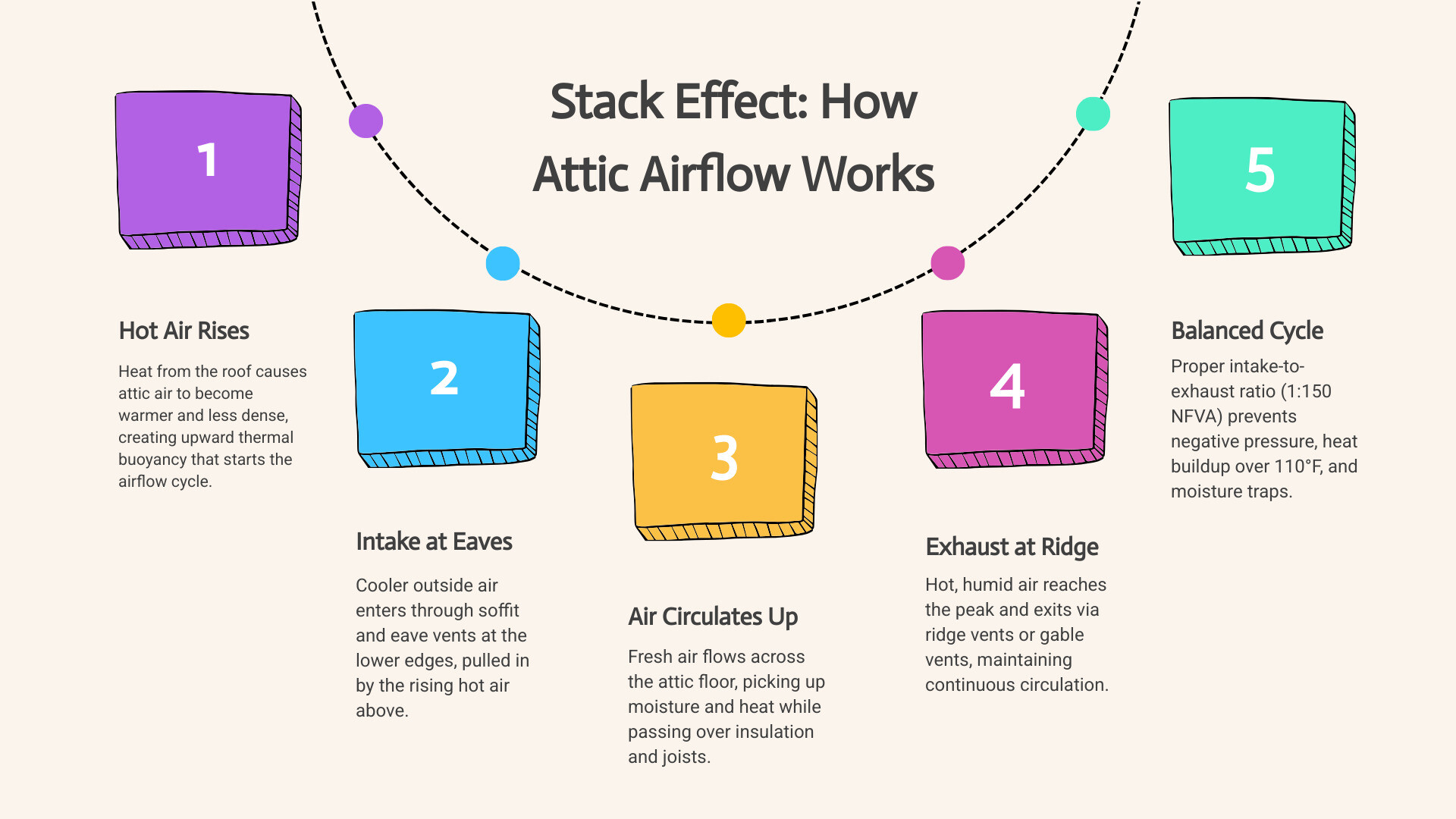
A “balanced system” means that roughly 50% of your ventilation is high (exhaust, like ridge vents) and 50% is low (intake, like soffit vents). This balance is critical because it utilizes thermal buoyancy (the “stack effect” where hot air rises) and air-pressure differentials (where wind blowing over the roof creates a vacuum that pulls air out).
If you have plenty of ridge vents but your soffits are painted shut or buried under insulation, your attic is effectively suffocating. This imbalance is why Proper Maintenance of Your HVAC System is Essential; if the attic is a furnace, your AC unit in the hallway is fighting a losing battle.
Recognizing Red Flags During an Attic ventilation inspection
During a typical summer day in Norfolk or Medfield, MA, your attic shouldn’t feel like the surface of the sun. A healthy attic should ideally stay below 110°F. If we find peaks of 150°F, we know there’s a circulation failure.

Here are the red flags we look for:
- Mold and Mildew: If you see dark spotting on the roof sheathing or rafters, moisture is trapped. This often happens when bathroom fans are lazily vented into the attic instead of through the roof.
- Rusted Nails: Look at the tips of the nails poking through the roof deck. If they are rusted, it’s a sign of “frozen condensation” from the winter. Warm, moist air from your kitchen hit those cold nails and turned to ice, then melted, causing rust and potential wood rot.
- Shingle Damage: Poor ventilation “cooks” shingles. If you see premature curling, cracking, or loss of granules on a roof that’s only 10 years old, the attic is likely too hot.
- Ice Dams: In the winter, if the attic is too warm because heat is trapped, it melts the snow on the roof. That water runs down to the cold eaves and freezes, creating a dam that backs up under your shingles.
- Stuffy, Humid Air: If you walk into the attic and it feels like a sauna, the air is stagnant. How to spot signs of trouble often starts with your own nose and skin—if it feels “heavy,” the vents aren’t working.
Evaluating Vent Types and Common Installation Mistakes
Not all vents are created equal. In our 30 years of experience serving areas like Franklin and Bellingham, we’ve seen every mistake in the book.
1. Soffit Vents (The Intake): These are located under the eaves. The most common mistake? Blown-in insulation covering them. We always check for insulation baffles—plastic or cardboard channels that keep the insulation away from the vent so air can actually get in.
2. Ridge Vents (The Exhaust): These run along the peak of the roof. A common “roofer error” is installing the ridge vent cover but forgetting to actually cut the slot in the wood sheathing underneath! It looks like a vent from the outside, but it’s doing zero work.
3. Gable Vents: These are the louvers on the side of the house. While they look classic, they are often inefficient. A major mistake is “short-circuiting” the system by having both a ridge vent and a gable vent. The ridge vent might pull air from the nearby gable vent instead of the distant soffits, leaving the rest of the attic stagnant.
4. Power Vents and Solar Fans: These use a motor to pull air out. While they sound great, they have a dark side. They can create negative pressure, actually sucking the expensive, conditioned air from your living room up through recessed lights and into the attic. This wastes money and can even cause “back-drafting” of carbon monoxide from water heaters.
5. Manufacturer Warranties: Companies like Certainteed have strict ventilation requirements. If your roof fails and the manufacturer finds you didn’t meet the 1:300 ratio, they may void your warranty.
Calculating Your Net Free Ventilating Area (NFVA)
We promised there would be a little math! Don’t worry, we’ll make it simple. Let’s say you have a 1,000-square-foot attic floor.
- Determine the Requirement: Using the 1:300 rule (for a balanced system), divide 1,000 by 300.
- 1,000 / 300 = 3.33 square feet of total vent area needed.
- Convert to Square Inches: Since vents are sold by the square inch, multiply by 144.
- 3.33 x 144 = 480 square inches.
- Balance the Load: You want 50% at the top and 50% at the bottom.
- 240 sq. in. for the Ridge (Exhaust).
- 240 sq. in. for the Soffits (Intake).
- Check Individual Vents: A typical static “box vent” might provide 50-60 sq. in. of NFVA. To get 240 sq. in., you’d need 4 or 5 of them. However, a continuous ridge vent provides much more—it takes about 15 static vents to equal the exhaust of just 42 linear feet of ridge vent!
Taking Action After Your Attic ventilation inspection
If your Attic ventilation inspection reveals issues, don’t panic. If you are in the middle of a home purchase in Waltham or Newton, these findings are powerful negotiation tools.
- Negotiation Strategies: You can ask for a price reduction to cover the cost of adding vents or remediating mold. Often, a price credit is better than asking the seller to do the repairs, as it allows you to hire a specialist you trust (like us!) to ensure the work is done to code.
- Remediation: If mold is found, “dry ice blasting” is a fantastic, non-toxic way to remove it without using harsh chemicals that could affect your Indoor Air Quality Solutions.
- Insulation Upgrades: Most homes in America are under-insulated. In Massachusetts, we recommend an R-value of R-49, which usually means about 16-20 inches of insulation. While you’re up there, we also recommend air sealing—using fire-safe caulk to plug holes around pipes and wires where air leaks from your house into the attic.
Safety Gear and Tools for a DIY Attic ventilation inspection
If you’re feeling adventurous and want to peek up there yourself, safety is the number one priority.
- PPE: Wear safety glasses, a dust mask (or N95), and a hard hat. Attics are full of fiberglass, dust, and protruding roofing nails.
- Watch Your Step: NEVER step on the drywall or the pink insulation between the joists. You will fall straight through the ceiling of the room below. Only walk on the wooden joists, or better yet, lay down a few plywood sheets to create a stable platform.
- The Pro Toolkit: We use thermal cameras and laser thermometers to find “hot spots” where insulation is missing or vents are blocked. For a DIY check, a high-powered flashlight and a tape measure are your best friends.
- Timing: The best time for a DIY check is Spring or Fall. Avoid mid-July afternoons unless you want to experience what it’s like to be a baked potato.
Special Considerations for Hip Roofs and Cathedral Ceilings
Not every roof is a simple triangle.
- Hip Roofs: These roofs slope on all four sides, meaning the “ridge” at the top is very short. There often isn’t enough room for a standard ridge vent to provide enough exhaust. In these cases, we might recommend “box vents” or specialized hip-ridge vents.
- Cathedral Ceilings: These are tricky because there is no “attic” to walk in. During an inspection, we look for rust on shingle nails or moisture stains around recessed lights. If the ventilation gap between the roof and the ceiling is blocked, the roof will fail very quickly.
- Unvented Attics: Since the 2009 IRC, “conditioned attics” (using spray foam on the underside of the roof deck) have become popular. These don’t need vents, but they must be perfectly sealed. If you have a “vented” roof design but someone added spray foam, you could be trapping moisture and rotting your roof deck.
Enhancing Home Comfort and Indoor Air Quality
At Accurate Baker Elman, we believe a home is a complete system. Your attic, your HVAC, and your breathing air are all connected. A suffocating attic makes your air conditioner work harder, leading to more frequent repairs and a shorter system lifespan.
By ensuring your attic is properly ventilated, you aren’t just protecting your shingles; you’re improving your Indoor Air Quality. Proper airflow reduces the chance of mold spores entering your ventilation system and keeps humidity levels in check.
We’ve been serving our neighbors in Franklin, Medway, and across Massachusetts for over 30 years. As a Mitsubishi Electric Elite Diamond Contractor, we understand the technical nuances of home comfort. Whether it’s a sweltering July day in Quincy or a snowy night in Hopkinton, your attic’s health dictates your home’s comfort.
Don’t wait for a leak or a $500 electric bill to tell you there’s a problem. A professional Attic ventilation inspection is a small investment that pays dividends in peace of mind and structural longevity. If you’re worried your attic might be gasping for air, give us a call—we’re here to help you and your home breathe easy.